

Do you visit art galleries and museums? Do you enjoy theatre and concerts?

As a garden writer and garden maker I deeply regret that my audience for both appear to be almost exclusively gardeners.
It is as if the works of painters and sculptors were only ever seen and discussed by painters and sculptors. As if theatres only played to playwrights and music of all kinds was only ever played and enjoyed by musicians. Gardens which open to the public are now perhaps expected to showcase plants and provide ‘inspiration’ to – gardeners. Or perhaps to be nature reserves for our desperate wildlife. And, increasingly, gardens are declared to be good for mental health. The mental health of the gardener.

The garden at Castle Drogo is said to have been designed so that the walk up the garden echoes our path through life. There is no longer any mention of that meaning in the information about it now.
We might think that gardens could equally benefit the mental health of the garden visitor.
A great garden may offer beauty, peace, intellectual stimulation, pleasure for all the senses and excitement in exploration and discovery.
Or a great garden may offer discord, challenge, a confrontation with banal expectations. Ian Hamilton Finlay cautioned “Superior gardens are composed of Glooms and Solitudes and not of plants and trees.”
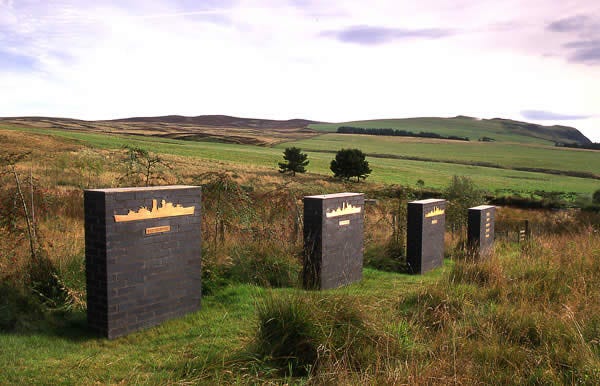
Little Sparta. Gloom and solitude.
In the 18th century gardens were considered a great art form. Horace Walpole said:
‘Poetry, Painting and Gardening, or the Science of Landscape, will forever by men of taste be deemed Three Sisters, or the Three Graces who dress and Adorn Nature’. (Horace Walpole).
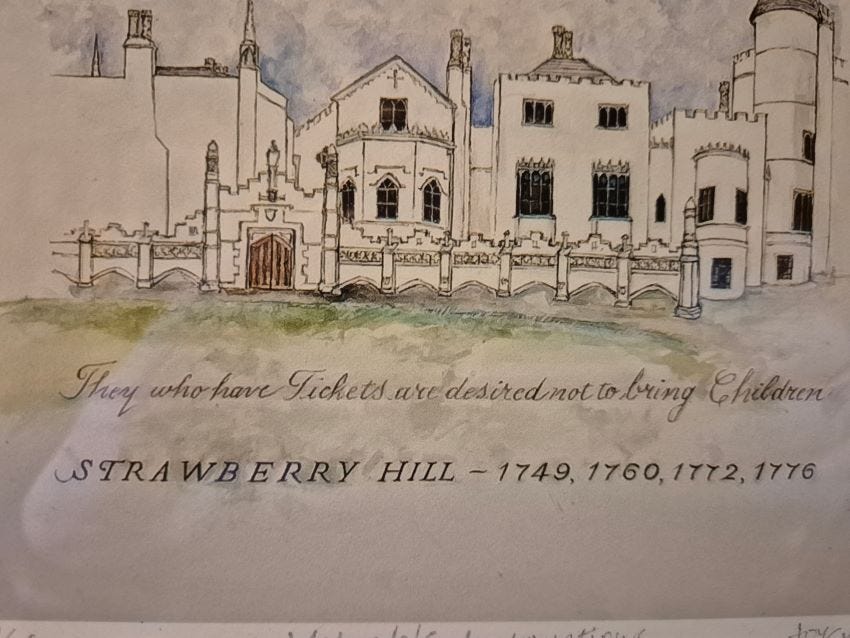
Garden visiting has not changed as much as you might imagine. Horace Walpole’s request of visitors.
I think we may have lost both men and women of taste, and poets too will be lamenting their loss of status. But you may be missing something if you think gardens are just plant zoos, mini farms, or wildlife sanctuaries. They can be so much more.
But if you decided that a great garden might be worth your attention, or wanted to demonstrate that to a non gardener, how will you find one which will reward your visit well?
Americans will have to tell me – I know it is very problematic in the USA. Try The Garden Conservancy? I can’t speak for that. How are those selected?
All British gardens are described as ‘lovely’. It wouldn’t help much to take a skeptical non gardener to visit a garden of random planting.
You may try to shove your way round Chelsea Flower Show. But that is a travesty of what a garden visit should/could be.
You may try a search on the National Gardens Scheme, intending to do a little for charity. You will find that all are described by their owners, which may not be the most objective review.
In the UK you could also try the National Trust or the RHS gardens, but on the whole you’ll find there that the creating spirit of the gardens in question is almost inevitably gone.
Wisley has a worthy exception – the new borders at Wisley designed by Piet Oudolf.
It has the enormous advantage of not being a dead man’s garden. It is original and contemporary. It lacks the immersive quality of some of our best gardens but it is full of life. It may challenge your notion of what a garden is and thereby take you to other new and exciting gardens.
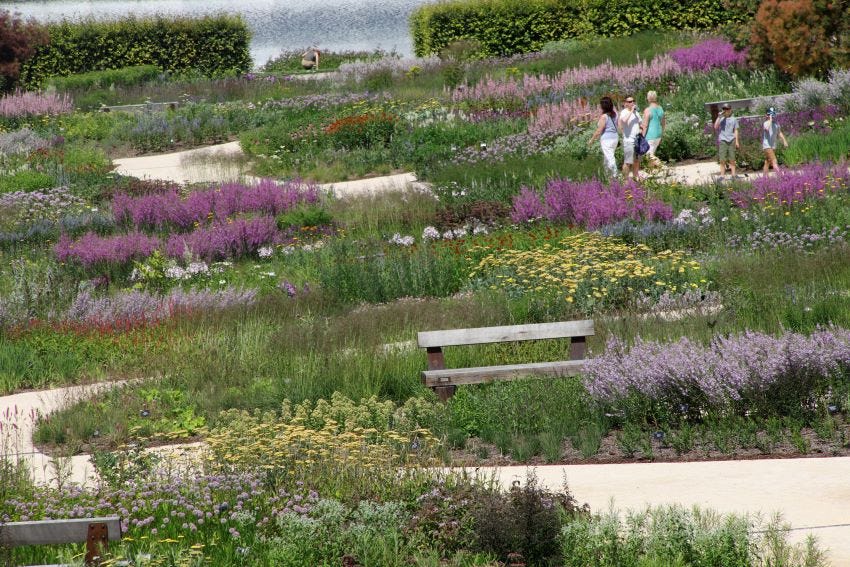
Suggestions for other exciting gardens (besides Veddw!) welcome in the Comments. In the UK there is a long list – so with inevitable weaknesses and inevitably mostly of dead people’s gardens, – in Great British Gardens.
Perhaps if you are a gardener reading this, you might do one good thing for our depleted culture:
Send or take someone you know who is not a gardener to a great garden that you know is worth their serious consideration.
And if, somewhat accidentally, you are not a gardener and have stumbled upon this post – visit a good contemporary garden and discover what this garden world has to offer. And maybe tell us about it?

This reads: “There is a taut balance in a shallow curve that other shapes cannot match.”
My apologies that this is so UK orientated, but it is something I feel strongly about and I feel is worth airing.
My thanks to Charles Hawes for several of the images.


Our local art and history museum has a 4 acre native plant garden, maintained by Master Gardeners, Master Naturalists and members of the Native Plant Society. Several workers have expressed that they are not gardeners but “observers” of how nature works, the plants in communities and the wildlife attracted by such areas. People taking art lessons at this museum are often found sketching and painting in the garden. The South Carolina Botanical Garden is of great interest to birdwatchers since the diversity of that garden attracts so many different species and their Peter Rabbit Garden has classes for children, not only on gardening but construction, art and crafting, and photography. I’ve been to gardens that have entertained the masses with high tea American style, and concerts, even dinner parties amongst the rose bushes. As I get older I believe I too will no longer be “gardening” but appreciating the work of others.
That’s very encouraging, Sally. Thanks.
I take your point that gardening is no longer as widely recognized as an art form as it once was, and I really like how you often remind us of that. Nonetheless, from observing and listening to people who go on garden tours or visit public gardens, I’d say there are still plenty of non-gardeners who appreciate gardens. As with music and the fine arts, nonpractitioners of the art can be arranged along a continuum from those who are extremely knowledgeable and sophisticated in their appreciation to those who are childlike or naive in their mostly sensory appreciation. No one can attain the former category (if they even wish to) without passing through the latter category. Glooms and solitudes, or too much visual chaos, or lack of cues to care will not help them get there. Finding other living things flitting and buzzing in the garden might get them there. The artful structuring of colours, shapes, textures, repetitions, etc. might also get them there, by appealing to widely shared aesthetic principles that a whole range of observers can appreciate.
I’m sorry if I bore you a bit on this topic! But I like your engagement. And agree that gardens can be appreciated on different levels. (https://gardenrant.com/2021/02/gardens-and-music.html)
I don’t think we would gain by dumbing them down. But we might by making them more challenging?
Not bored by the topic at all, but keenly interested. It keeps coming up, doesn’t it? I’d like to see more on the actual techniques of garden aesthetics. What constitutes a good garden as art? That quality does not have to stand in contradiction to other purposes like habitat, “loveliness” for the amateur, usefulness to humans, or whatever. I mean, that’s the game, isn’t it?
Well, there’s the beginning – these things need much discussion, examples, ideas, a language.
When will it start???????
I am wondering what you think about the sculpture garden at the Hepworth Wakefield Museum. Not only does it attract interested folks who come for the visual art, it is free and open to the community at large. I imagine it also attracts garden lovers who come because of its numerous seasonal changes, and/or because it was designed by Tom Stuart Smith. Is this something you would like more of? I sure would. I also think about The Lurie Garden in Millenium Park in Chicago. This is a very heavily used garden, again with lots of seasonal changes and is a part of a much larger park containing large artworks and interesting architecture as well as hosting numerous events for the general public. Also designed by Oudolf, The Highline in NYC is beloved by New Yorkers. Perhaps these three examples are exceptions to the rule, or maybe you are thinking more of private gardens versus public. I look forward to hearing your thoughts.
Interesting thoughts and examples. There are some great sculpture gardens and sculpture can raise a mediocre garden into one of interest.
Ideally, garden and sculpture should work together, talk to each other. So where sculpture is for sale and transient this is unlikely.
Piet Oudolf has, I agree, brought gardens into public consciousness – a great step forward. The downside is perhaps that they are generally great public works rather than a personal expression. But then, art has always had to have its patrons.
And maybe most of all – too many of us are simply obsessed with collecting plants! There is more to a great garden than plants and planting.
I have been thinking about this since I wrote my previous comment. Heavily used public spaces have so many requirements to meet besides the actual planting and design. The decisions are about needs like accessibility, for example. Not necessarily a detriment because those practicalities are very important. But they may lead to removing certain complexities as a trade off for an easier “read” or ease of use, clarity of purpose, and so on. All good principles and I do not malign them. I feel like you might be writing more about the specific moments which have a conceptual component where we get to see and feel the thoughtful and/or playful mind of the maker. These are not always immediately legible, often requiring time and interpretation. I have noticed in the visual arts that viewers are very good at this, but do not think they are, and are reluctant to undertake it for fear of being “wrong”. And often, gardens don’t have much of this type of thing going on anyway or any way to offer the viewer permission to interpret or any hints to get them started even thinking this way. Thanks for getting me thinking, Anne!
I really do think that the greatest possibility for those specific moments will be in a personal garden.
And we will not get the most interesting, exciting and creative personal gardens without a change of focus.
Or at least a general acknowledgement of what the best gardens are capable of offering.
And then adding the permissions you mention?
I agree and after this exchange I will take on the challenge to do this in my own garden to a greater degree. Thank you.
Then let us visit and appreciate?
I recently visited Leonardslee Gardens with my son, pandering to my interest but sparking his curiousity. It is a huge site with much to enjoy with lakes, woodlands and fabulous sculptures – we had a great day out, finishing off with a glass of their own wine! We commented on how many families were enjoying a day out there as they seemed to have struck a happy balance to satisfy all visitors. I do however struggle to maintain his interest in gardens with just horticultural delight ….
PS Loved the Piet Oudolf garden!
There are gardens which may add to your son’s understanding of what a garden can offer. We really need a good source of information about gardens which add some meaning, some challenge and some true beauty beyond attractive planting. Something to inspire the next generation.
I completely agree that gardens are much more than functional spaces. They can be places of inspiration, creativity, and deep personal connection to nature. Perhaps you could highlight specific examples of what gardens offer—like a sense of peace, a canvas for design, or a way to connect with history and culture. This could inspire readers to see gardens in a new light.
Thank you for this and there’s thoughts for further posts. You saw this one? https://gardenrant.com/2022/05/words-and-things-in-gardens.html