


Original landscaping shown in this 1938 photo.
Since moving to Historic Greenbelt, Maryland, where evergreen hedges are ubiquitous – and usually in the way – I’ve become almost obsessed with how awful they are and begun collecting photos of prime examples of their awfulness.
Why do we have so many hedges? They’re part of a 1939 utopian plan that kept yards open to the community in the front and back, with only short hedges allowed around or between them. The intent was that residents would garden and gather communally, rather than in private yards.
(Other attempts at social engineering, like quotas by religion and rules for marital and employment status, not to mention racial exclusion, are long gone. The city may be a New Deal project but it’s still a product of its time, and not always in a good way.)
So the original hedges are now too large, and more hedges have been planted because our co-op allow only a tiny amount of the 6′ tall fencing typical in the back yards of townhouses.
It’s frustrating to see my neighbors forced to use plants where there’s not enough room or sun, only to be overwhelmed by pruning regimens they can’t keep up with or even know how to implement.
So over on my local blog I wrote this hedge rant, which I’ve edited slightly for a broader audience and copied here. I know from following gardening subs on Reddit that screening is a widespread problem and hedge plants like Arborvitaes are openly hated, so I suspect that my local situation with resonate with many of you.
Problems Caused by Hedges Today
Hedges are high-maintenance and the maintenance required is high-skill

Pruning expert demonstrates technique for overgrown euonymus.
Pruning hedges, especially in tight spaces like ours, is an advanced horticultural skill. Proper pruning technique for health and reduced maintenance over time isn’t intuitive at all and requires experience. So I hired a professional, highly skilled pruner to come show us how to do it. Here’s her advice, with photos and video.
But pruning requires more than skill – it steals your time! One resident told me it takes four full weekends to trim their hedge, twice yearly.
The expense of hiring pruners
That same member told me they’ve paid between $600 and $1,500 for someone else to prune their hedge, depending on their skill level.
The species used are poorly suited to the job

Euonymus hedges left and upper right. Lower right is privet.
Almost all our old hedges are privet or euonymous – nonnatives that aren’t even well-adapted ones. One is listed as an invasive plant in our region.
About privet, according to UMD, “All species of privet present in Maryland are invasive and spread into natural areas by seed. Birds eat the berries and aid in seed dispersal. Border privet and European privet in particular can form dense thickets in natural areas and impede the growth of native plants, such as spicebush in the forest understory.”
Many hedges simply don’t get enough sun to fill out and be healthy – see the example in the collage above. Awfully leggy.
About euonymus, Greenbelt historian Stephen Oetken tells me that the ones planted here were “varieties of the plain green Euonymus (typically Euonymus japonicus), praised for its dense, glossy foliage. It doesn’t seem to be on the market anymore; the closest I can find is the narrower version – ‘Green Spire’ is a narrow, columnar evergreen reaching 6 to 8 feet tall and 1 to 2 feet wide, perfect for tight spaces. Needs at least 3 hours of direct sunlight to maintain its dense vertical form. There are lots of diseases and pests known to affect euonymus.”

Many evergreen species chosen by members eventually become far too large for the site. Above left and right are two conifer examples; in the center is a photinia, which is far too large and very prone to leaf blight.
The expense of buying new or replacement shrubs

My front hedge in 2019.
I started an arborvitae hedge in 2015 and four years later it looked like this, which shouldn’t have surprised me, given that they’re not particularly drought-tolerant. But I had no irrigation system and I didn’t do as much hand-watering as I should have, so I wasted about $900 on Arborvitaes. With hindsight, even if they’d survived the drought, Arborvitaes were the wrong shape to block my view of the parking lot – their primary purpose.
I wasted another $450 on five evergreen Cryptomeria trees to block the view of garages beyond my back garden. It also proved to be too large and the wrong shape for screening where I needed it.
Monocultures of single species are especially vulnerable to disease, and all it takes to spoil that perfect hedge is one plant’s demise. Instead, experts recommend hedges with a mixture of species.
Waiting years for the desired screening, if ever
For new hedges to create adequate screening is at least a five-year wait, and there’s no guarantee that the new hedge will ever create the evergreen screen where it’s needed.
Problems for the community
Branches hitting humans, even cars
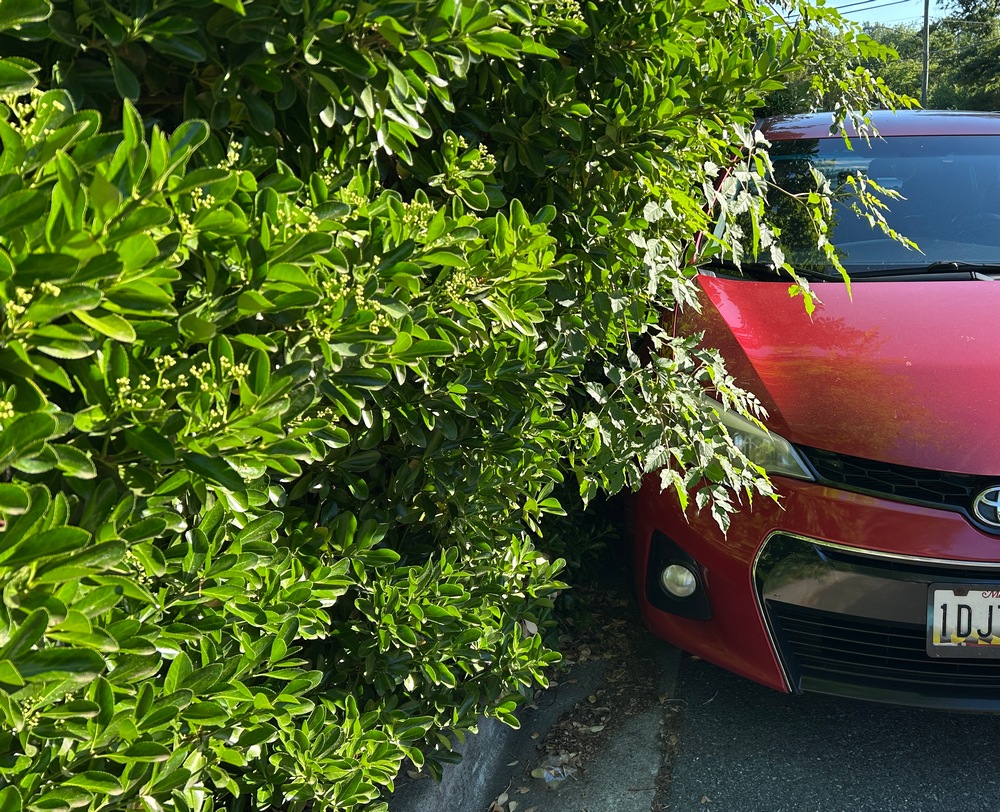
This is a common complaint heard among residents – hedges impinging on inner walkways and sidewalks along the street, as shown here.
Reducing safety and/or the feeling of safety from harm-doers

The original 42-inch hedges allowed pedestrians to see people coming from every direction. Now, tall hedges like these can harbor criminals, or at least create the feeling of danger for pedestrians, especially when walking alone at night.
Contrary to the intended openness, hedges have walled off parts of our community


While I completely agree with the horribleness of the examples you give, the word “hedge” to me conjures a quite different image: birds flying in and out of healthy shrubs (mixed species or, I admit, monoculture, but if the latter, a shrub that is well suited to its situation and loved by wildlife). Arborvitaes jammed together are not a pretty sight, but a line of trimmed Carpinus caroliniana/American hornbeam providing cover for birds is something else altogether. (And with my totally excellent Japanese hedge shears, there’s actual pleasure in the trimming)!
Mixed native hedges are tons of fun, although admittedly best if there’s no need to trim them hard, and I love having the mix of blue berries from Viburnum nudum, white from Symphoricarpos, pink purple from American beautyberry/Callicarpa americana and the spectacular red pods and berries from Euonymus americanus, not to mention the white flowers, blue black berries and red fall foliage of arrowwood viburnum, and all of this with some shade. In a sunny spot, the choices are endless!
None of this negates your point, but I had to put in a good word for hedges! I think plants never look good when they are treated as furniture. And unloved furniture at that.
“I think plants never look good when they are treated as furniture. And unloved furniture at that.”
Love this! And YES to wide multi-species hedgerows, which like the great ones you mentioned. (Maybe they’re also called hedges? Anyone know?)
I planted a yew hedge 30 years ago to give a break from the street. It’s now waist high, kept at that height by the ever present deer. I can’t post pictures but imagine a 3 point buck in a suburban PNW neighborhood browsing on the hedge. A friend in Seattle had his laurel hedge removed when it was costing $3000/year for pruning. The arborvitae hedges are pruned to a penile shape by the deer. ♀️
Yes, plants don’t always grow in the shapes and sizes we’d prefer. No plant will grow to the dimensions of a fence.
I think 18″-30″ pruned hedges can look quite nice to establish an orderly feel that can balance out wilder plantings. And they don’t impede sightlines, which is often my preference. Boxwood is the classic plant for this, but dwarf yaupon is a more resilient choice for most of the southeastern US, dwarf Chinese hollies are also suitable, yew often works in cooler climates, dwarf Pittosporums are popular in California, and I always enjoy seeing what other plants people try to use (excluding ones too vigorous and lanky for the job, like Abelia or Photinia).
When sightlines should be blocked, I’m afraid plants are only a good solution when there is plenty of horizontal space as well. A staggered combination of *unpruned* evergreens can look good. Here in NC my favorite combination is ‘Green Giant’ or similar arborvitae, interspersed with ‘Yoshino’ cherries highlighted against the dark green background. But this is much wider than a hedge.
I think the Japanese gardening tradition has the best mastery of how to make walls, fences, and even short sections of bamboo or wooden screening look aesthetic while blocking undesirable views and creating privacy. Williamsburg also has very nice brick walls, and Berkeley has artistic tall fences and gateways, for inspiration.
And if you hate staring at hardscape and don’t have space to plant much in front of a wall or fence, adding some narrow (but supported) plant touches like a vine or espalier can be a beautiful combination.
As much as I like Greenbelt’s original vision of low hedges and long vistas, sometimes enclosure is preferable. I think hardscape, rather than tall hedges, is the best tool for that when horizontal space is limited.
Also, as a parent of young children, my main use for enclosure is to keep toddlers from wandering out of our yard when I look the other way. So we installed a 3′ tall wooden fence with a 3″ gap between each picket, which attempts to minimize the impact on sightlines while still being kid-proof. Kids are much better at darting through hedges, so they’re fairly useless for that need anyway.
Thanks Susan. We indeed see the invasive privet in our Greenbelt Preserve and the GHI woodlands , but not a lot, so privet is not a catastrophic invasive (unlike bamboo and wisteria…) but it seems to spread more readily in our gardens. If a GHI garden is not maintained carefully it is almost guaranteed that at least one privet seed will find its way there and grow, especially at the edges. They look pretty awful when grown “wild” without the traditional privet haircut.
Thank you for clarifying that the label of “invasive” may or may not reflect actual threat to woodlands or other natural areas. The word is to often thrown about, as I did here, to demonize a plant, with no evidence that it’s potentially harmful locally. I’m glad we have you and the whole Woodland Committee to guide the community toward eradication of the two plants that are harming our woods now – wisteria and bamboo.
I sympathize. When I think of hedges of old, in California, I think privet. Now in southern Oregon, I think boxwood and I love mine. The hedges you illustrated are way too much.
The pruning bill is what finally did it for us. Our neighbour was quoted £850 for two trims a year on a 12-metre privet hedge, so we replaced ours with a loose mixed planting of hawthorn, hazel and blackthorn instead. It needs one light tidy in February, cost about £120 in bare-root whips, and the blackbirds moved in within the first season. Screening without the maintenance contract.