


We just needed a way to get up to the Magnolia Walk.
And I had read how important it is to be generous with the width of your paths (so then also, presumably, your steps) in a garden. So I got myself a spade and began to dig. I know you’ve seen other steps in the garden but these are the Biggies. And the Biggest Mistake.
Charles maintains he worked on these steps, but my memory is better than his and I know that he was earning our living while I was shovelling soil to make the steps. It was another big effort. Somewhere around 1995
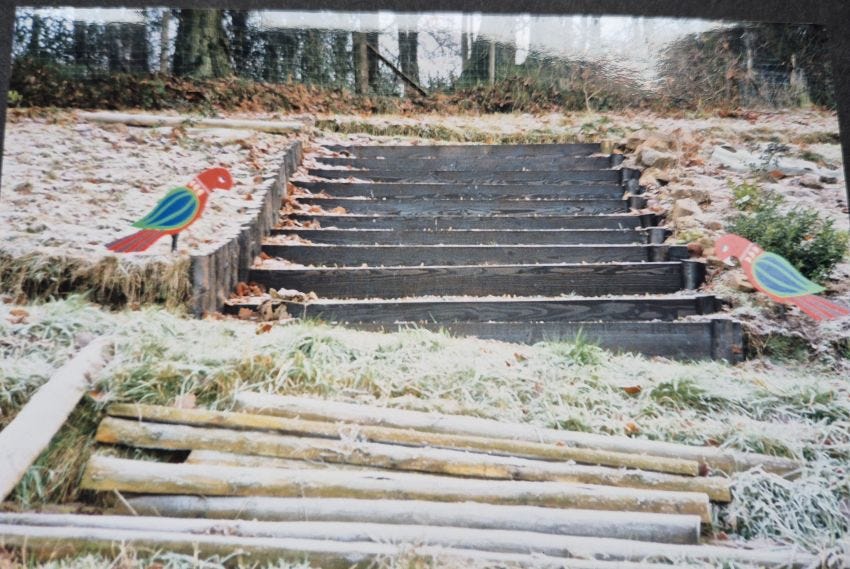
I made the parrots but they weren’t quite at home there.

There is one left which now lives happily in Charles’s topiarised yew tree.
Anyway, here’s the big story.
We used to ask people who visited the garden to tell us what they would change. or get rid of. And one day in 2010 Stephen Anderton visited. You can see from these photos that we clearly used to spend our time looking admiringly up these steps. Stephen looked down. And pointed out to us that we had framed a wonderful view of the garage.
Hm. Not nice. The very next day we were out removing the holly hedge which edged the steps and removing the steps themselves – as recorded in Gardens Ill.
We were left with rather squat steps, which had always been too wide, as Charles had previously helpfully noted in the photo album:

Now just half as much step but the remainder still too wide.
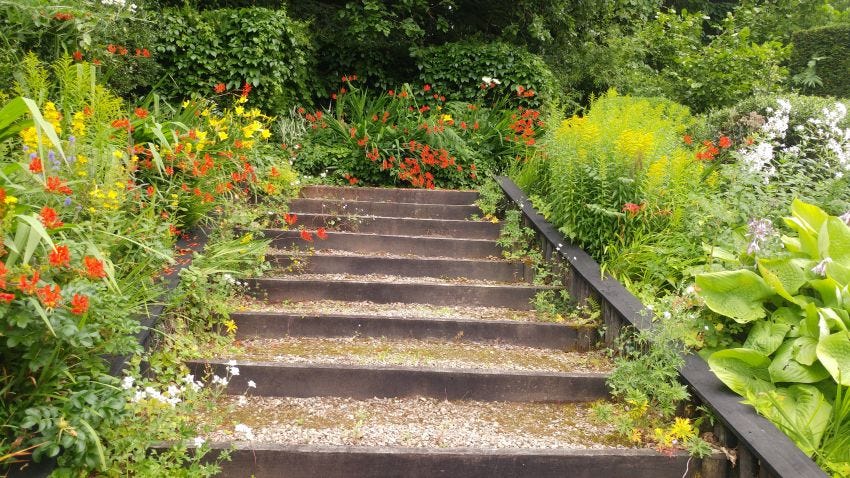
Where’s all that empty space at the back gone!?
Another of our welcome critics had something to say about these steps. Rory Stuart wrote a book which you must get a copy of: ‘What are Gardens For?’ Rory had three things he thought we should do something about, and you’ll have to get the book to find 1. and 3. (Or I’ll tell in another post if you ask nicely) Here’s 2. –
“A short flight of steps between two holly hedges are too wide for the space they occupy, an unusual error of judgement in a garden where proportions have generally been carefully considered. It turns out that these steps are the remains of a much longer flight, which has now been abbreviated – showing how this garden (like most gardens) is still in the process of development.”
So what to do about the width?? It was all solidly built with borders of plants and not easy to alter.

And a useful place to give talks from. With thanks from a recipient of the that talk – jewelsofthegarden Instagram
Much thought.
Then, after many years, observing the effect of some weeds, wildflowers and seedlings in the steps, it occurred to me that they had a brilliant role. If carefully selected, they are very pretty. And they sort of change the effect of the width of the steps – at least to my mind. (No-one else has yet commented.)
The best thing is, though, that they slow down the step climber or descender.. You have to pick your way carefully, looking down, we hope, at where you are putting your feet. What a great way of making people look?! Sweet flowers, so small as to go missing in a large garden, now in focus.
Well, that’s my excuse, and I do love the steps with their little flowers.
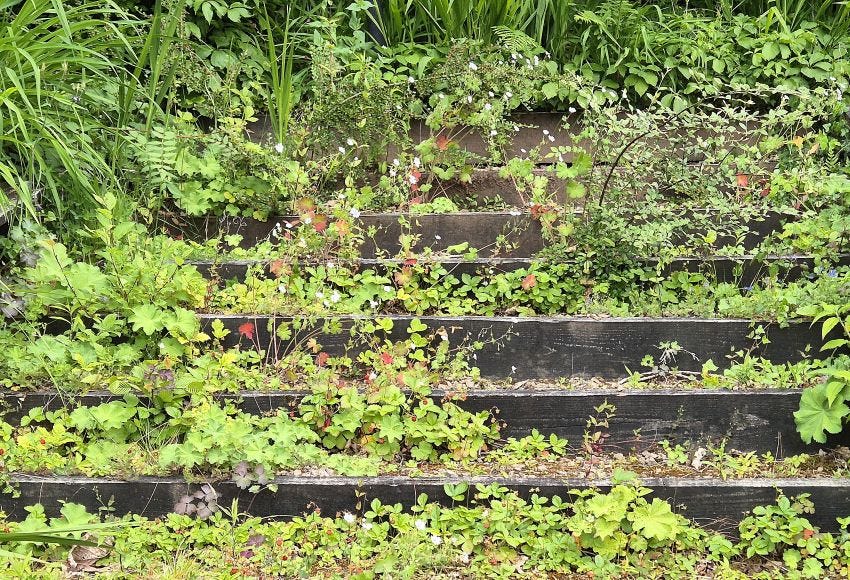
Err.. maybe too many little flowers…..

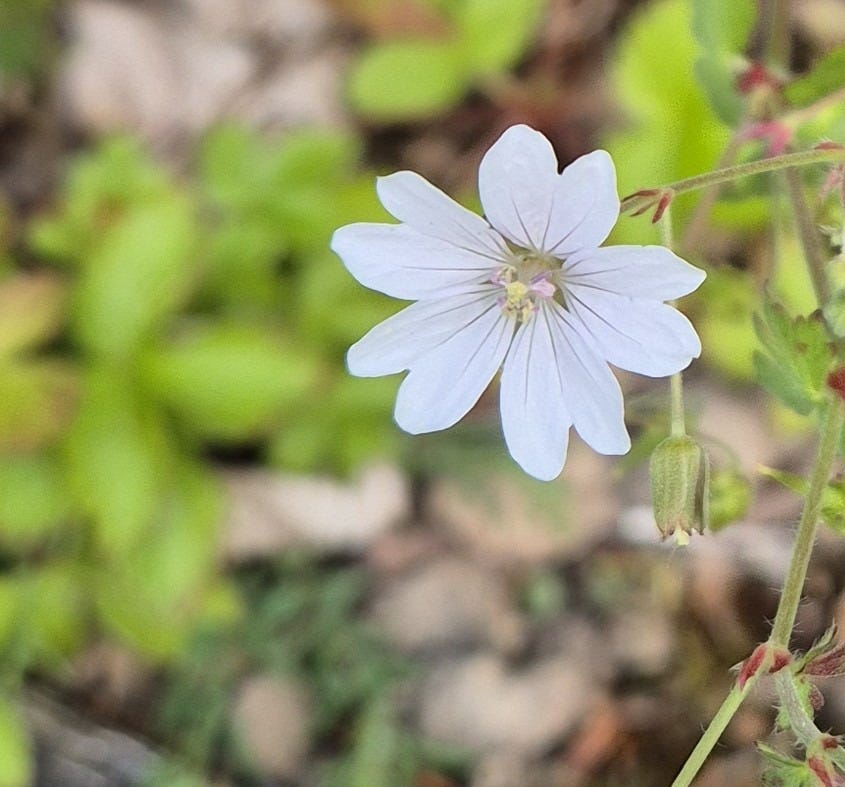
Someone weeded it once. I’m still waiting for it to really return in decent numbers.

Who doesn’t love this one?
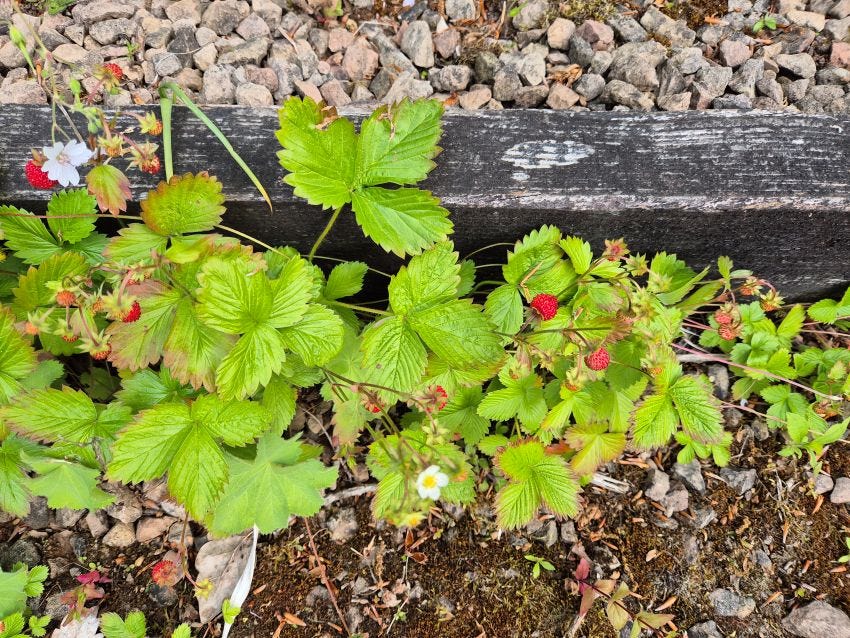
And this, of course, provides a sweet nibble as you wander.
Despite this liberal approach to seeding in the steps, weeding must be done. But weeding at the Veddw is a delicate and challenging task. Those little white flowers, despite being ‘invasive’ nearly got weeded out completely once.
And worse, much worse – not long ago Charles dug up a sorbus which had seeded there and damaged himself terribly badly. He has not recovered, sadly.
There are Crocosmia Lucifer in the borders – and at the top. Which is a tall and falling over type of plant. I should think some people would stake it. Charles took dramatic action, given the lack of stakes, and brutally confined them. I love that too!

They look well squished there, but I think will be happier this year, growing into their confinement, as it were. The piece of lathe he used came from the Cornfield Garden, which is a story for another day.
Useful tip: I learned this year that if chopped down early in the summer, Lucifer will happily come back at have the height and self supporting.
Charles.
I like to think that most of what Anne says here is familiar to me but this post was a revelation. Not entirely accurate as far as the construction phase is concerned: I’m sure that I wacked in a good many of those side posts which make the sides. But we also dealt with the Garage View issue by planting a holly hedge at the bottom of the top flight, which now blocks the view of the garage, apart from the roof, which is a Green Roof anyway.
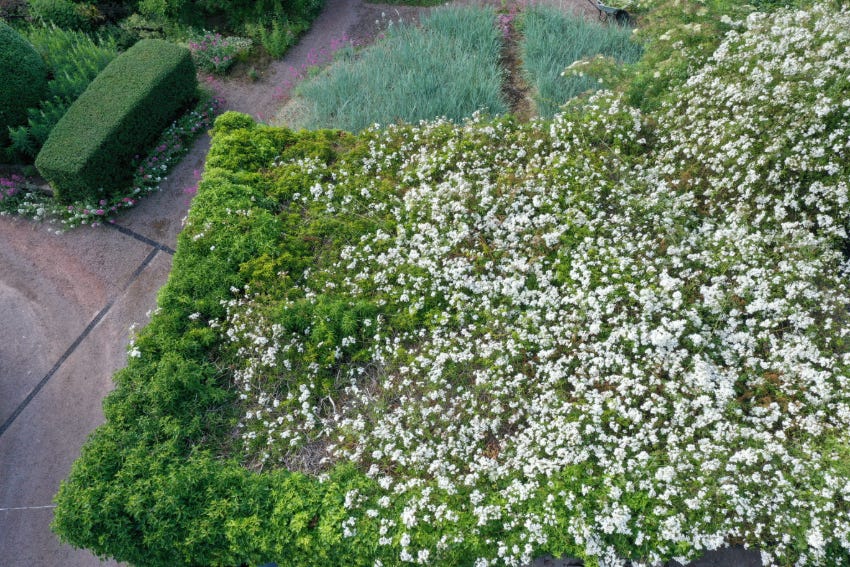
The Garage Roof – covered with various green things and a Kiftsgate rose. Photographed by Charles with a drone – you don’t get this view from the remaining steps, or anywhere, unless you’re flying.
As for the step treads, I had rather ungenerously thought that the messy planting of apparently random plants was Anne just being a bit lazy, where as it seems that she had a Cunning Plan, which, come to think of it, does exactly what she says. She’s very clever. And I am slowly recovering from my injury and the transplanted sorbus tree is doing well.


It has a mysterious lost garden and forgotten steps look , and I love it. The garden I work in has steps to nowhere, and I think some of the ideas I see here might inspire. Whimsical as well!
I love the idea of managing steps to nowhere and perhaps making that their meaning.
Every time I get overwhelmed and feel visionless, I come over and read one or two of the posts in this series. And now, because Michael has been to The Veddw, I send them over to him too. You wouldn’t believe how motivating it is for garden building and garden muddling. -MW
Thank you. I so want that to be the case, given the perfect, designer made gardens people are so often confronted with pictures of.
It’s hard, it’s mad but it’s possible.
So enjoy reading these many posts on the creation of your garden! Do hope you’ll share number 1 and 3 of Rory’s suggestions in another.
Noted!
You bet Anne. The perfect dare I say static gardensp are best left with the Japanese and Chinese gardens of the world. One idea struck me as a way to take away the view of the garage. If there was room Have the steps not as wide to be able to add terraces that change the direction of the steps and create side views as one traverses zig zag down the slope. And end with a lovely gardened apron at the bottom.
Great idea but a bit late!
And cars get parked at the bottom……
Must consult with you the next time one of these conundrums arises. Can be hard sometimes to see things with a fresh eye.
Interesting to hear the thought process behind the steps, Anne. And thank you for the book recommendation. I promptly ordered a copy of Rory’s book.
Hi Pam – I hope you find it interesting. Good book, important question, I think.
The steps are too wide? Far better to have ample steps than cramped ones, particularly in an open garden with visitors. I find them hopelessly romantic, and I also love to let little plants grow in crevices. I have done the same thing in the 3 concrete steps leading from the sidewalk to our walkway to the house. A neighbor walking by exclaimed, “you even have interesting things growing out of your cracks!” We both got a good laugh out of that.
Nice one!
1 and 3 please and I will still order the book. I find solutions to garden design come more easily at 2:00 am. It is often difficult to not go into the garden immediately to see if it will work. Thank you for your column.
I am in Upstate New York.
OK to 1 and 3, if not today (having a weekend off and it’s not my turn here until Thursday) – but I can’t guarantee to have them drop into your lap at 2 am New York time…..
Though that’s a useful tip and will try to stay awake when I’m stuck.