


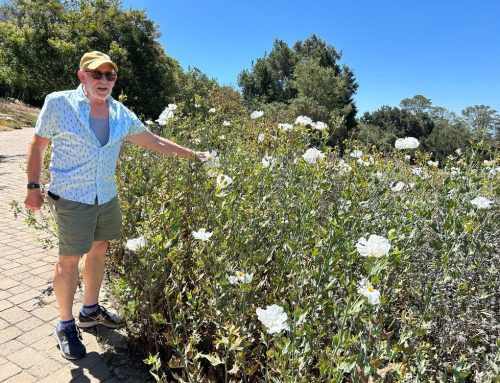
My photos from (L) somewhere near Toronto and (R), in beautiful West Seattle, GardenRanter Lorene Edwards Forkner’s very own garden.
If you’re a member of Wild Ones, you may have noticed my short article in the latest issue. Wild Ones is a national nonprofit with 99 chapters and what they call “seedlings” in 37 states; its mission is promoting native landscapes. (Members can read the whole issue here.)
Wild Ones was interested in my collection of Lawnless Front Yards on Flickr, which I hoped would help people who wanted more from their yards than just turfgrass. Front yards are the trickiest places to go lawnless (HOAs, local ordinances, neighbor relations) and people need to see alternatives that will work even there, and can be used in back yards, too.

L: my photo in Takoma Park, Maryland. R: somewhere in Colorado, garden and photo by breecorn on Reddit, with permission
But replacing lawns with gardens like these means becoming actual gardeners, which means tons of learning, hard physical work (often more than mowing), making mistakes, etc. And most of these gardens will require more work than the lawn they replaced. This is an important warning because sadly, most of the people asking me about lawn replacement are looking for NO-maintenance, which we know isn’t a real thing. They should stick with their barely-good-enough, turf+weed combo that they mow a few times a season. Or pay the kid next door to mow.
Okay, I’m ranting now but some people are just happier living in an apartment, with not a square foot of land to take care of. And I mean no judgment here; for me it’s cooking – no interest at all! But when it comes to yard size, it can be hard to find an alternative, thanks to zoning that typically prevents denser housing outside the cities.

My photo of friends’ garden in Historic Greenbelt, Maryland.
Replacing whole lawns is a great opportunity to spend time on your land NOT walking behind a mower but enjoying an outdoor living space with lots of different plants, plus seating and maybe a firepit. I love to see gardens like that, especially in the front!
And surely the plants used, from groundcovers to trees, will provide more ecological services than turfgrass.
But clearly what new eco-gardeners need help with design. And that help needs to come from the gardening world because it’s hard to find in the “go native” and anti-lawn messaging I’ve seen.
So I’m happy to hear from Redditors and others that the 287 images on the site so far are helpful. My article about reactions to it will appear in the next winter issue of Wild Ones.
How it started for me
Wild Ones also invited me to do a short piece explaining my connection to the topic of lawn replacement, which just appeared and is copied below. There wasn’t room for photos of the garden that I wrote about, but thankfully there’s plenty of room here.

My former back yard, where I replaced lawn with sedum and clover. Which I don’t recommend. Takoma Park, Md.

Close-up of white clover dominating the shorter Sedum sarmentosum.
One of the minor edits has me wondering how to handle plants with no commonly used common name – like “stringy stonecrop” for Sedum sarmentosum. Actually, what stumps me most often is how to capitalize common names, which I’m sure I do incorrectly and make the better horticulturally educated among you, including my GardenRant partners, cringe.
I heard right away from a new native-plant gardener near me suggesting we get together, so that’s fun.

As you can see, this issue covers fire, and there’s one more article about lawns and homeowner associations.

Summer 2026 issue of Wild Ones Magazine


I always forget about Wild Ones – I keep meaning to check it out, so thanks for this.
And for lawn-killing, itself, it wasn’t even the lasagna method, per se, but a lazier version of it: I just threw down a ton of cardboard in single layers (with the staples and everything removed), hosed it down, then dumped a lot (a lot) of leaves on it. And since I was using leaf litter as mulch anyway, as I was building an understory garden in a woodsy yard, it was kind of a no-brainer to do it that way. And it worked really well! The weeds were kept down, the soil got a nice head start, and I could dig through the cardboard when I was ready to plant. And the paths were all done in the same manner, just finished with arborist chips instead of leaves.
But, yea, it’s all a lot of work – I’ve ended up removing probably 5k square feet of lawn so far over the past three seasons now, but I’m a gardener; I’m in it for the long haul.
Very impressive! The largest lawn I’ve ever removed was 1000 ft.² so I just say wow
The lawn in my backyard took care of its own removal. I already had quite a bit of garden with some grass in the middle. But then over a few summers, the grass stopped growing, no matter how hard I tried, and nature replaced it with moss. I gave up on the grass and would never go back. I love my moss and keep it clean to help it survive and pull the random weeds that pop up. My front yard has the least grass of the neighborhood, but I am not sure I want to remove it. It takes me only five to ten minutes to mow and the space helps me get around to the plants.
Good point about where lawn is useful.
Gardeners who can go without a lawn are so fortunate. I wish our HOA would allow full-garden front facades, because I would absolutely go for it. I’ve taken as much turf out as I could get away with. Like you, I’d much rather be gardening than cooking.