

If you have a biggish garden it becomes necessary to name bits of it. It means you can discuss those bits when you’re not in them, and in an ideal world send someone off to do something useful in them.
The bit I’m about to write about is not much more than an entrance, or a path leading to an entrance. Here it is:
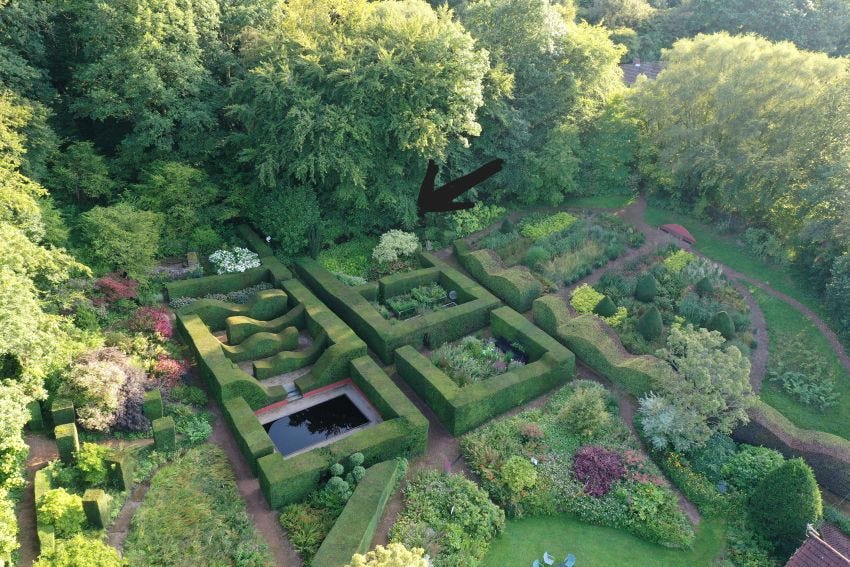
Come to think of it, it looks quite big there.
And so it wasn’t obvious what to call it. And out of conceit I named it after a relation I love my association with – Joseph Addison. You may forgive me a little that I wanted to acknowledge my kinship, since he also wrote about gardens, and he founded the Spectator. After discovering my connection with him it became one of my ambitions to write for the Spectator and I have! Four times! (see here)
Oh, if we could dissolve the distance time makes, if I could have met him….He died over 300 years ago.
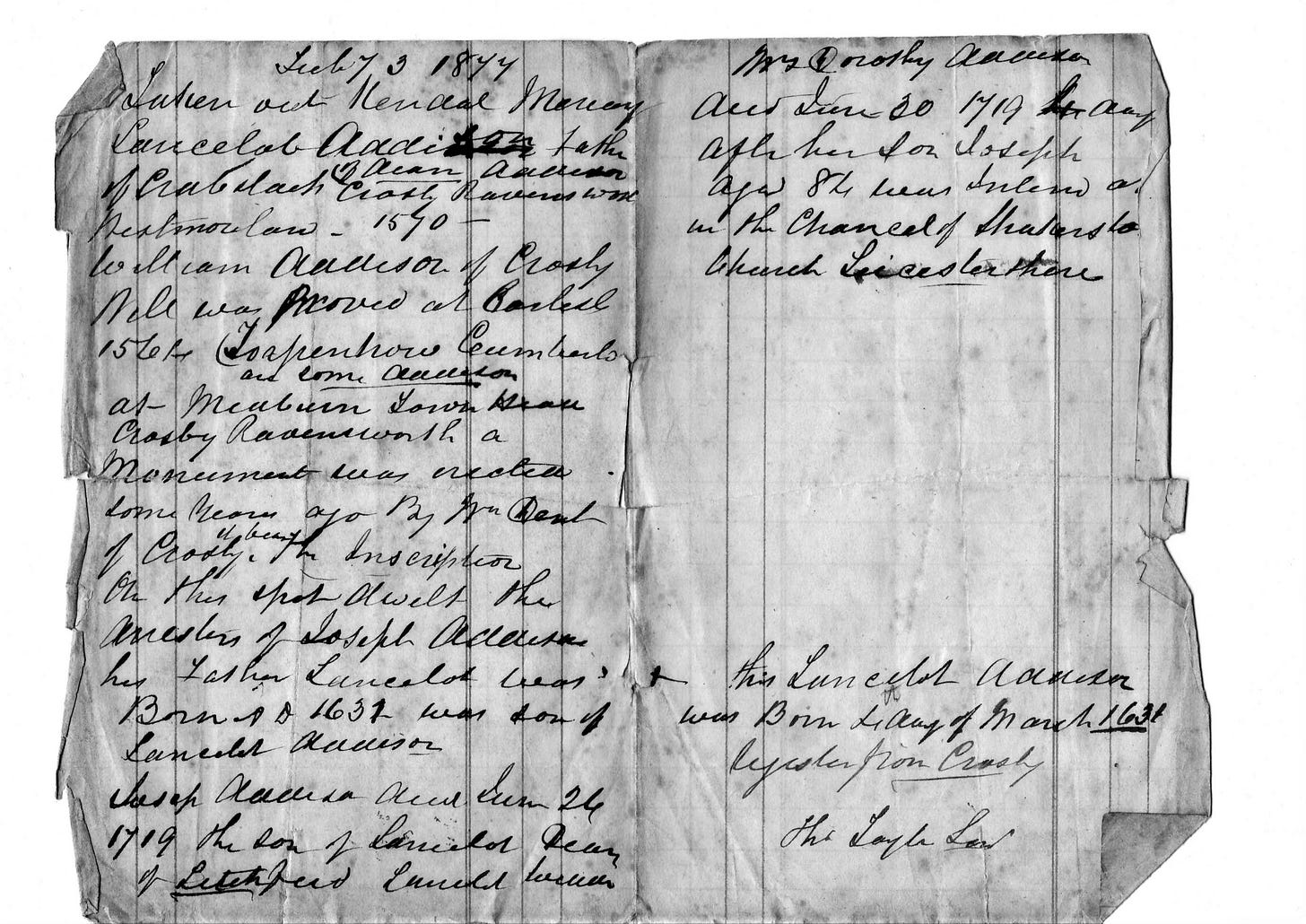
Part of a great family document, telling me the connection.
And now we are a bit embarrassed that I called this bit of the garden after him for no good reason and kind of fumble what we call it.
Anyway, we love this little part of the garden. It may almost be perfect in its modest way. If it didn’t have a load of irremovable carpet under a bit of it. Here it is before the planting took off:

The path is edged with stone roof tiles which were usefully piled up in a corner of the garden. Presumably removed from our cottage. I wonder if that rock actually adds much or is just practically impossible to shift… The rock is sitting in a large area full of Victorian rubbish and rubble, which remains, untouched, waiting for the archaeologists. And curiously, although this area is underneath some beech trees, there is moisture somewhere, evidenced by the plants that are growing happily where no plants should. (Or they were, until this year’s drought shook them. I think they have survived).
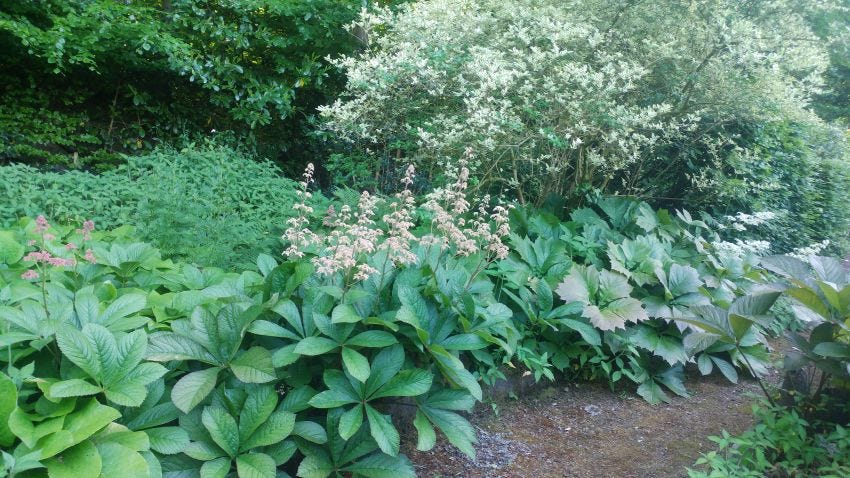
The planting is Veddw simple. There are just five plants: Trachystemon orientalis, Persicaria campanulata, also known as Koenigia campanulata, various Rodgersia aesculifolia, Koenigia alpina, and some rather random Aconitum napellus. And a bit of vinca has sneaked in.
There was also a privet, which I planted with the notion that when it was in flower people would walk in accompanied by a wonderful scent. At least I think it’s wonderful. I think some people don’t like it.
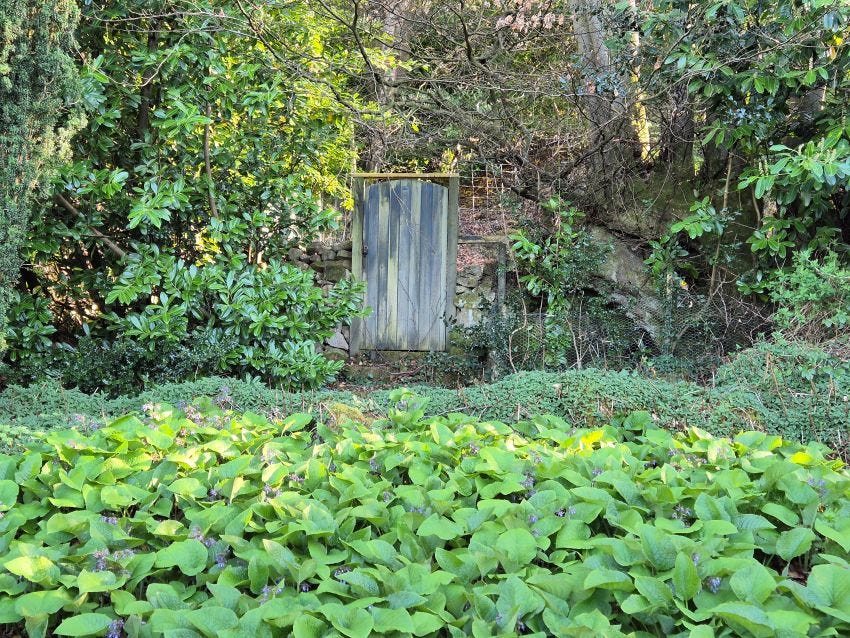
A door needing painting?
The year starts with the appearance of Trachystemon orientalis. (above) It has quite pretty blue flowers but it’s the leaves that it’s about. It manages somehow to create a sense of a pool. Sounds daft, but I’m not the only person to have thought so.
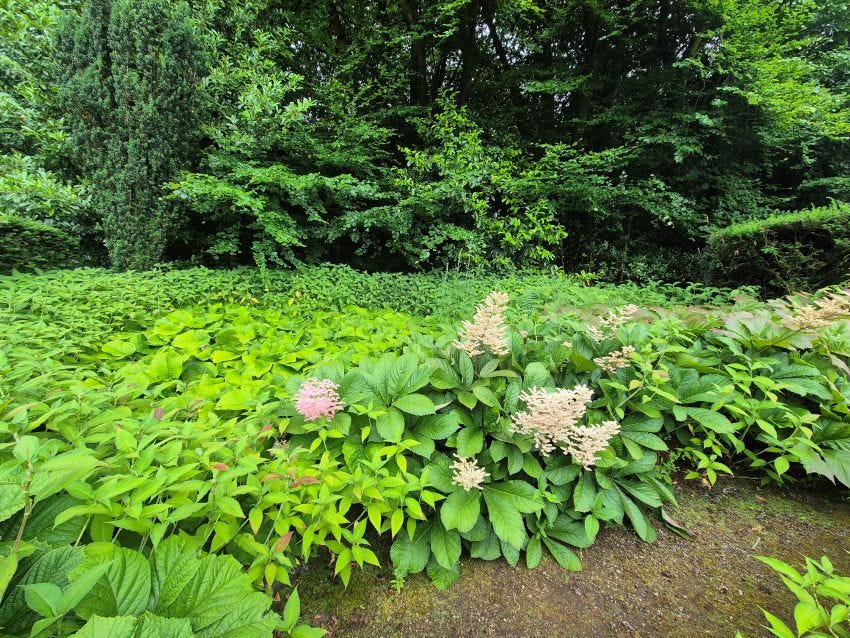
Poolish?
Then all the rest of the foliage emerges, and it is, really, the foliage which is the solid pleasure of this space.

With the privet
The privet began to die off in bits (this IS Veddw, you know..) so this spring we asked Angus to cut it down. He did and then almost overnight the rodgersia spread and grew and just went bam!

So it’s even better without the privet. Simplicity wins. And I love Rogersias.

The carpet? Under the Persicaria campanulata, which seems to do pretty well on top of it. It was there originally to clear the ground, got forgotten and now proves that the world is getting fatter, as it has disappeared under several inches of soil.

And, another Veddw detail – just outside this part of the garden is one of our dug up rocks. one You’ll remember us digging up boulders. Well, this is one of them. I love this one for its wrinkles.

Charles
Visitors often ask us what our favourite part of the garden is. An impossible question really. But I really love the simplicity of this area (we took far too long to get rid of the privet). And it hardly requires any maintenance – just weeding out the occasional interloper. The roof tile edge is fascinating as they must have come off a roof of ours – but if so where did all the others go? Sold off perhaps, but why leave some?
Anne keeps asking me to repaint the door (visible in one of the above pics) into the area below our car park, but I like its distressed look. What do you think?


Please, Charles, won’t you paint the door?
He won’t. (Yet……)
I’m all about the leaves. Annoys me when plant catalogues just show a close up of the bloom. And envious of your Rogersias. I can’t get it to survive. Paint the door to protect it from the elements. Or you could put deck sealer on it and would look the same.
A bit more drought and we’ll have trouble with Rodgersias.
Charles is being obstinate about that door and wouldn’t even want to stop it fading. It’ll be his fault if it falls apart!
I know Anne won’t like this but I like the door the way it is. If it was painted, it would look a bit out of place – it would stand out too much.
I feel your pain about drought. This part of Maine is in severe drought and other parts are in extreme. We’ve gotten half an inch here and there this month but not nearly enough to make the deficit of nine inches or more. Sigh.
The Rogersias are lovely – the color is so inviting. No more privet!
Thanks, Kris – but in my defence we did paint it originally. And I thought it looked good then. Hm….. However, Charles will appreciate your feedback no end.
My sympathy re drought. It’s a troubling, difficult thing.
Before I put on my glasses the door looked like a little waterfall.
Ha! I can see that. It kind of has movement.
This is my first comment here, but I agree with Ingrid. I thought it was a waterfall at first. I love the door and agree with Charles – don’t touch it! I would love to have a space in my new garden to install an old door.
OK. We are lucky enough to have that space – and also much else to do. It will stay as it is for many years yet.