


Way back in 2007 I was one of three garden coaches profiled in the New York Times, a story that CBS Sunday Morning picked up on immediately by interviewing me for a segment that’s no longer online, but the text is here. I coached for money until 2011; now I just volunteer my coaching for other members of my housing co-op.
Anyway, when I discovered two wonderful coaches in my social feed, I wrote to them with this subject line: “OG garden coach seeks interview,” and of course they said agreed. So let me introduce you to two similar gardening coaches that I follow in their very different social media feeds.
Amy Powers and PowersPlants
Amy Powers lives in the Chicago area but coaches virtually anywhere in North America. She describes coaching here, and then here she gives lots of heads-ups to her clients – listing what she’ll do and won’t do, telling clients to come prepared, take notes, to use her time wisely (at $135/hour). Like a businesswoman!

Where I follow Amy online: videos on Facebook, Instagram, and TikTok. She told me she makes all the videos herself, and one 90-second video can take two hours to make. Chicago area folks may also see Amy on local news shows.
What does she know SO MUCH?
That was my big question for Amy, because she’s taught me things about plants I’ve grown and was unaware of – calling Echinaceas a “short-lived perennial.” (No wonder I’ve had such short-term success with them!)
So unlike me, Amy has a degree in chemistry and calls herself she’s a scientist at heart. So she researches the hell out of plants, especially the native ones she recommends, and her favorite source for them is Prairie Moon Nursery. There she learns where the plant is found in the wild, from which she surmises important details – especially how much water they really need.
No shaming or blaming!
Of course she’s learned a lot from experience (growing up in a gardening family) and credits the native plant community for teaching her more. But unlike too many advocates for native plants, she doesn’t shame anyone for growing nonnatives. While her videos teach the whole range of gardening – soil, pruning, design, hating on landscape fabric, and much more – the plants she recommends are native, and her enthusiasm for shrubby St. John’s Wort was enough to make me try it. (Just planted one.)
But her helpful videos don’t exclude nonnatives – she’s happy to teach peony care or how to prune lilacs. She told me she tries to “meet people where they are” and indeed she does.
In the rare video about an invasive plant she includes details too seldom mentioned – exactly how and where they’re invasive, even including images of burning bush, for example, in the wild where it’s taken over.
So Amy is the rare eco-gardening proponent who’s inclusive, teaching not just the ecological topics about gardening, but teaching gardening itself: How to grow healthy plants and create a pretty gardens. Click to see her showing off a client’s garden after just one year.
How she got started coaching
It all started with videos she made for her family back in Canada who were experiencing gardening problems. Her video about hydrangeas went viral (it’s always hydrangeas!), people started asking her for help, she quickly developed a wait list and quit her job doing IT consulting.
What we need from Amy
I’ll confess that I’ve either learned from OR agreed 100 percent with everything I’ve ever heard Amy say. And because she give the instruction that newbies attracted to ecological/native gardening so badly need, I nudged her as hard as I could to create webinars and other online instruction – which people will pay for! (Benjamin Vogt reveals that his average webinar has 270 attendees, at $30 each – do the math!)
Turns out she’s already working on some “long-form content,” focused on water. For that project she’s interviewing a hydrology professor at Notre Dame and has long discussions with her scientist son about water. She got so excited talking hydrology with me, I had to steer her back to my questions!
Jessica Zander at Youcandoitgardening
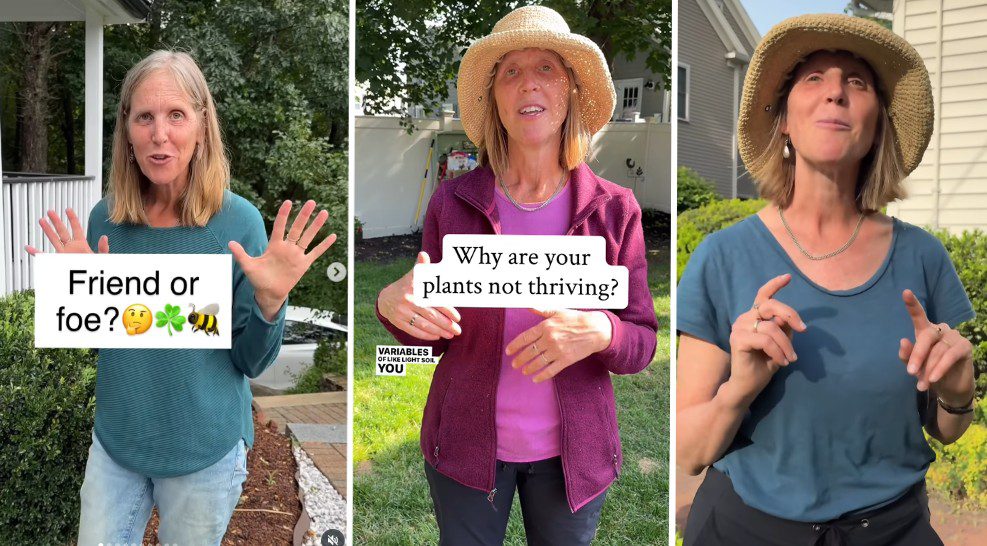
I’m also enjoying the videos of coach Jessica Zander talking to her Boston-area clients. In fact, the videos are made BY clients, FOR them, Jess told me in our chat. Clients hold their phones while she shows them what to do in their very own garden – changing border lines, moving plants, pruning, getting rid of plants, with plenty of laughing while she’s doing it. Her coaching advice reminds me a lot of what I used to tell clients, but with a lot more personality.
Jess’s design and pruning videos are top-notch (meaning, I agree with them 100 percent), and I agree with a friend who told me she finds Jess’s videos “addicting.”
And gotta love the title – You Can Do It Gardening – and the attitude it conveys. Per her website: “Doing it yourself can save you a LOT of money and be very satisfying and rewarding too.”
Jess and I discovered while chatting that we don’t agree on everything, but a lively back-and-forth has followed and hopefully will continue. She has an open mind and I’ll try to have one, too.
Coaching
Just like Amy, Jess enjoyed success in business before turning to coaching. She’s been at it longer, and Amy actually booked a session with Jess to pick her brain about coaching, which Amy told me was a huge help. Jess also coaches in person or virtually, and charges even more – $200/hour – you go, girl! (And I have no doubt that even at that hourly rate she’s saving clients beaucoup bucks.)
I love her style, which she acknowledges on her website is “direct and to the point – like Mary Poppins, but for your garden.” I was pretty direct, too, but I think it lands better coming from Jess.
Where to follow her: Facebook, Instagram, TikTok and YouTube. Jess also appears frequently on local news stations, giving excellent seasonal advice.
Bio
Jessica has 30+ years experience gardening and a 30-year career in nonprofit finance and operations. She started garden coaching in 2022 and went full-time the next year due to the high demand for her help (according to her about page).
Hiring a coach yourself
I learned that people have told Amy they’re getting their Master Gardener certificate so they can set up business as a coach, a notion that honestly made me shriek into the phone! (That certificate guarantees nothing about anyone’s knowledge or experience. I once blasted my own MG training in DC.)
My advice in choosing a garden coach? Make sure they’ve been gardening for at least 20 years, and check out their own garden to see if it’s the kind you like. (If it’s not shown anywhere, I’d take that as a warning.)


Wonderful post, Susan! Thanks so much for featuring me in this and may the conversations continue! Jess
Susan,
Thank you for introducing these two accomplished women. I clicked on the Master Gardener DC scandal link and was fascinated and appalled. It took courage to do what you did.
I’m interested in the fall out and what happened in the intervening years. I can google of course but do you have vetted sources.?
I look forward every week to this post.
Thank you,
Marie Tulin
I don’t believe there WAS any fall-out. The agent we wrote about finished her career there and retired with full pension.
I love this. I have been following both Amy and Jess on Facebook for the past year or so and love both of them. I am also in zone 6B (SW Michigan) so their posts are especially relevant. In particular talks about invasives. I live on 10 acres and have my fair share (hello autumn olive and multifloral rose). They both educate and inspire me to do better.
I’d like to throw my hat in the ring. I also coach and consult and sound very much like Amy in my approach. I just wish I had 2 hours to make more 90 second videos. Where does she find the time? Ecological gardening is exploding in my area (New England). I just hired another gardener and still have a wait-list. And after that little tidbit about Benjamin Vogt, I’m definitely going to look into webinars for the winter.
Look me up on all the social medias!
Thanks Susan!
Oh boy. “Garden coach.” Because apparently, the idea of just gardening wasn’t marketable enough — you have to make it sound like CrossFit for petunias. And the branding. “OG Garden Coach.” I’m sorry, but if you preface your title with OG, you’re officially in the influencer-industrial complex, not the horticultural one. What’s next — “Life Coach for Lawns”? “Therapist for Thirsty Ferns”?
The best part is the solemn insistence that coaching is different from gardening, landscaping, or (heaven forbid) being an actual horticulturist. No, no — this is guidance. This is wisdom. This is paying someone to tell you: “Water it less.” Which, frankly, you could get for free from a passive-aggressive neighbor leaning over the fence.
So should “garden coach” count as a real expertise? Sure — in the same way “closet organizer” and “crystal reiki pet healer” are “real expertises.” If people are willing to fork over two Benjamins an hour to be told their echinacea is short-lived, then congratulations: capitalism has once again found a way to monetize common sense and slap it on TikTok.
Yes. Paying for expertise. What a novel concept. Sure I can borrow a pipe cutter from my neighbor Jane and google some YouTube videos on how to relocate a sink or I could call up my certified plumber Mary and pay her to do it right. Gardening is no different. There s a glut of bad gardening information out there but anyone who relies on a neighbor’s advice or a short form video made in a different zone to inform their watering and planting and maintenance is throwing their plant budget into the wind
Excellent response!
I don’t respond, typically. But we’re always curious to see what will infuriate B next!
Amateurs parading around as self-important pros typically does it.
Sounds like AI has been at the comments again Susan. 🙂 I like the idea of having a client film you as you tell them what to think about in their garden. It would be tough at first to be comfortable, but in the end they would have a reference that went beyond scribbled notes. More for their money. And boy that is money. You and I and all the other writers are in the wrong business ! — MW
That’s funny, Marianne, I also said that I was in the wrong business when I saw what these sessions bring in! I do what these gals do, but I do it for free. Not knocking them and their ability to make money, mind you.
And Susan, the notion of someone registering for a Master Gardener course so that they can become a garden coach is hilarious. The MG program I completed left a lot to be desired.
All of that said, thank you for introducing us to these two ladies. I’ve already watched several of Amy’s clips and am looking forward to seeing what Jess has out there.