

Roses – yes, we’ve got roses!
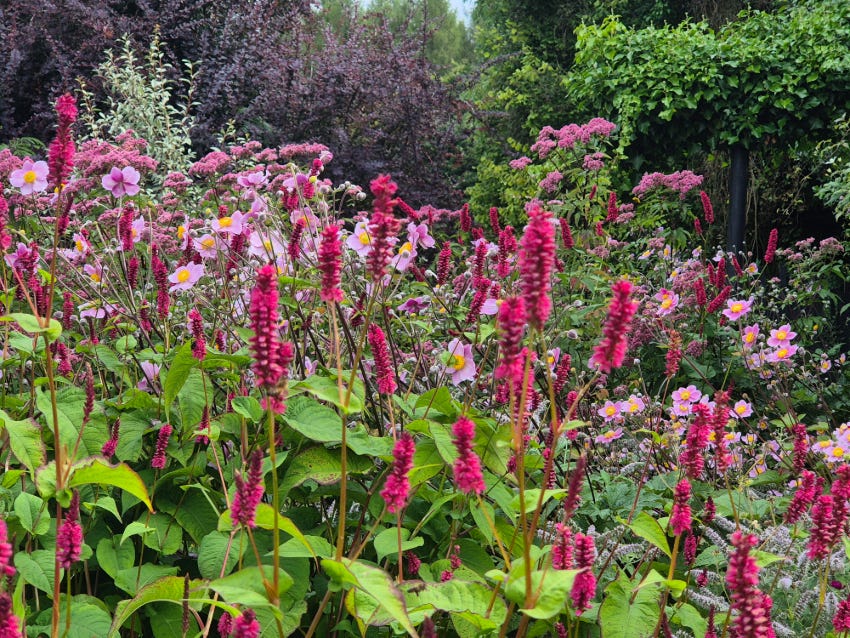
The photos are not very rosey, but this is August. The anemones are the star right now.
So we do have roses, but by now you will have realised that Veddw is not like most gardens. So, in my usual unusual way, I have one large bed with seven or eight roses – all of them Rosa Felicia, a hybrid musk. Going back to the beginnings of this bed, I find the advice I followed in Better Gardening, by Robin Lane Fox:

Yep, I planted a row of Buddleia Lochinch behind a row of Rosa Felicia.
Elsewhere RLF tells us that ‘Of them all, (the hybrid musks) the queen is the shapely silver pink Felicia, my unhesitating choice as the loveliest rose for any gardener. Felicia has no vices or diseases. She lives as long as most gardeners and can be pruned as a bedding rose at a height of three feet. She belongs with silver leaves and pale blue flowers, one of those breeders miraculous breaks.’ Well, he’s not wrong about that and Felicia can also remain unpruned and bigger and is just glorious in flower.
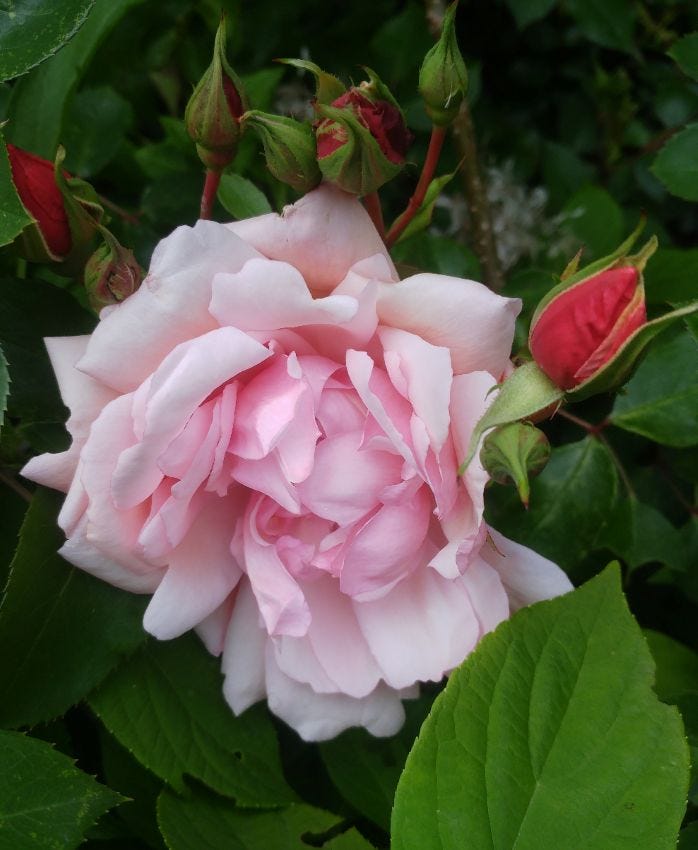
Wonderful scent too, that reaches beyond the sticking your nose in territory.
But the buddleias – what a pain. I can’t find a single photograph of mine and that tells you a lot. If you take pics the way I do, obsessively, any unphotographed plant or part of the garden wants dumping. It’s not doing it for you. The buddleias never did butterflies the way they are advertised to – the cardoons in the Veg Plot maybe distracted them. They go over badly but are too floriferous to deadhead. And they needed cutting to the ground every winter – no small job. So they were demolished.
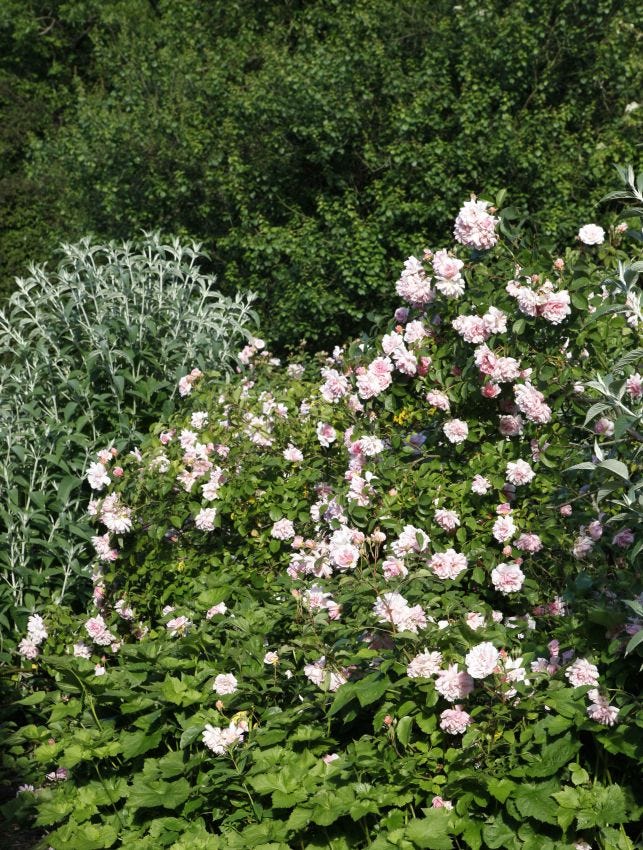
Charles managed to get a rather washed out photo with the buddleia though.
And one of the rare butterflies –

Great pic, Charles!
Felicia flowers twice, so in an extravagant mood of careless optimism we added the clematis Princess Diana to grow over them and sex up the second flowering.
This doesn’t work. Though, as ever, it has taken us several years and much attempting to clarify that. One problem is that we don’t remember late flowering clematis in spring, so the slugs usually gobble up the new tender shoots. If any of them escape they climb into the roses, (the shoots – happily not the slugs) as intended, and get in the way of deadheading the roses for the second flowering.
How come? Well, the sensible way to deadhead a bed full of roses is with a hedge trimmer and the clematis are not fond of that. And then there’s clematis wilt. Are we likely to escape that?


Here they both are, wrong way round. The pale pink is in the Felicia Bed, the crimson is across the path.
So I am working hard at adding crimson flowers to set off the pale pink roses and Japanese anemones – the late, sticking up persicarias:
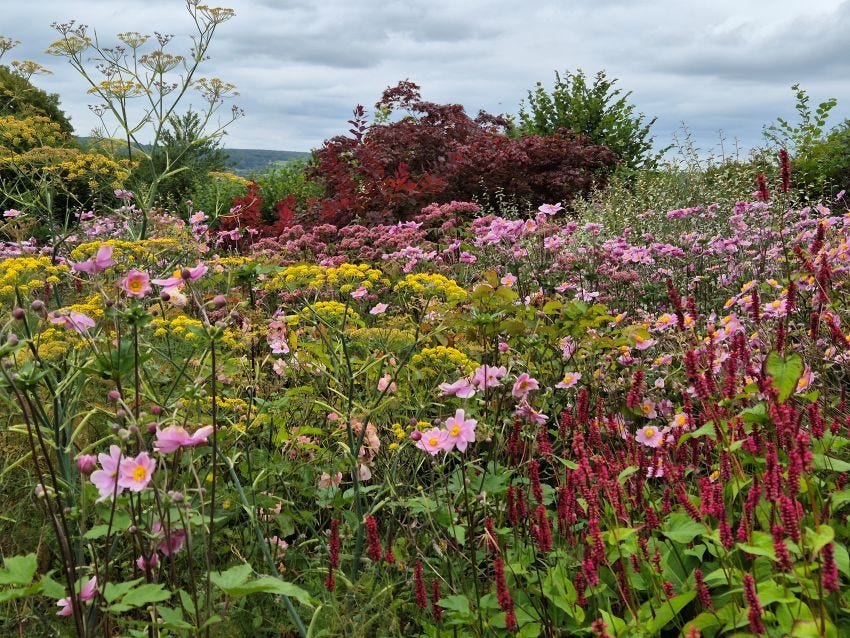
Not sure which persicaria it is – there are several available and I have probably added most of them.
I also discovered that I like the yellow of the bronze fennel, as well as the brown of its earlier foliage, in here. And the really really great addition (for me) is Eupatorium cannabinum ‘Flore Pleno’, described by Bob Brown (with a currently erroneous photo) as – “(Double hemp agrimony.) Solid powder pink flower heads Jul-Sep, 1m. Easy. Lovely planted near roses. All the stamens that make the single flower grey have changed to pink.”
I love it and am waiting for half a dozen of them to get BIG.

And my latest addition is one most people would avoid like the plague, but jumps around happily at Veddw, delighting us from August for six weeks or more: Clerodendron bungei.


And though it wanders like mad once you have it, it’s hard to propagate, it seems, as it costs an awful lot. But I have now managed to get it into the Felicia Bed and it will no doubt go rampant in there. As it has in the Front Garden and on the edge of the Meadow. But it’s just the right colour and nicely will extend the season. (It will!) All that will sharpen up the pale pink.
Opposite all this there is the Leymus Bed –
just in case you thought we’d finished with rampageousness. It’s full of Leymus arenarius with a sprinkling of valerian. It didn’t start like that, of course. It originally featured lavender:

On the top of the glamorous garage is Rosa Kiftsgate. It’s big.
Here’s a better pic of the lavender.
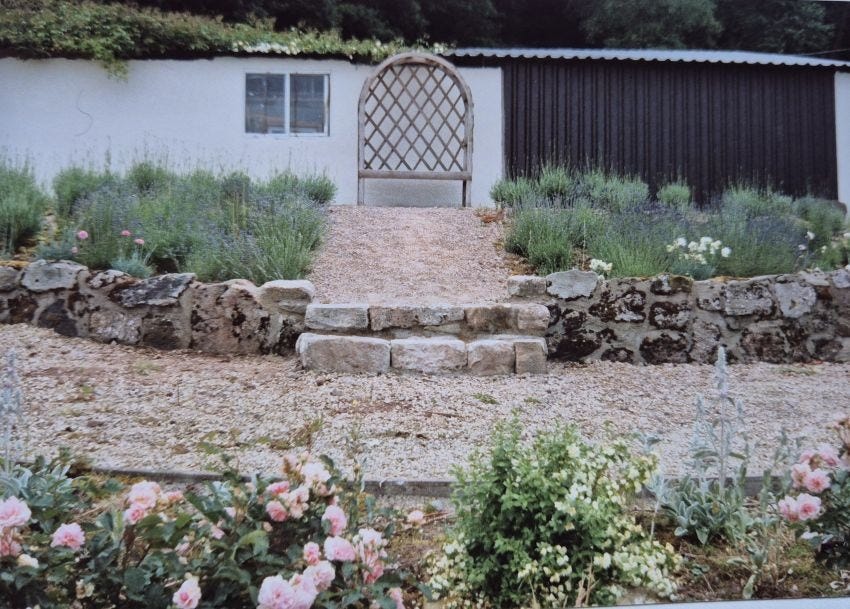
Looking uncharacteristically neat and tidy. This is because this was over 30 years ago. Pity that seat rotted. Wood!
And here’s Kiftsgate from above:

There is nothing like a drone……
– Well, the rain came pouring down off the garage roof, as you (being sensible) would have predicted. Lavender struggles in the West of the British Isles anyway, without being regularly swamped. So the lavender went. (Noticing a theme here?)
The leymus might also have disliked the wet, but actually it thrives and gives me one of my favourite views of the garden.

Along with another joy, the valerian. Which is flourishing round the edge –


And just in case you are wondering where all this is (do you like a plan or a map, so you can see where you are?) – here:
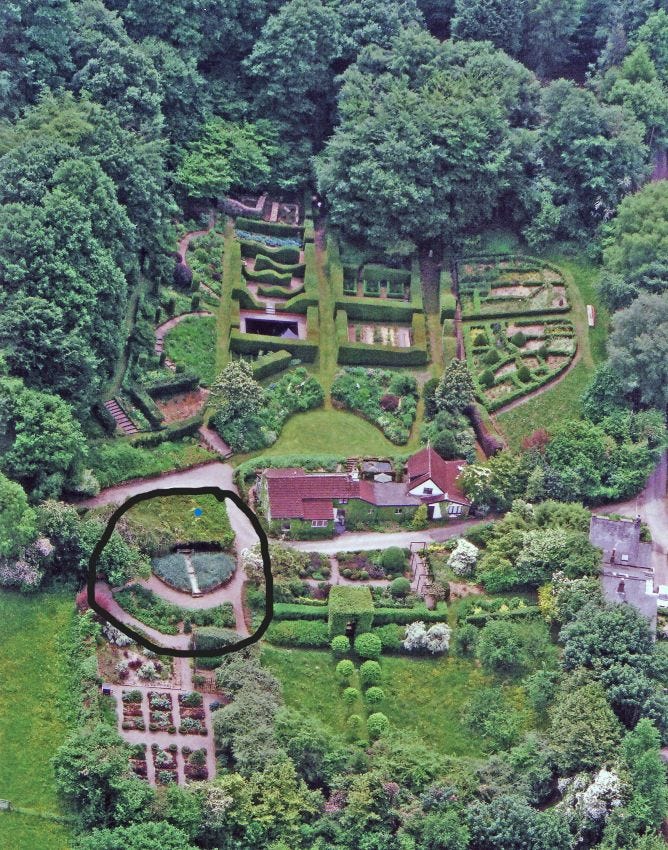
Yes, – you could play spot what’s changed from this oldish pic.
Charles
I’d almost forgotten the first planting of what we now call the Leymus Bed. And as Anne posts these historic images from different parts of the garden I’m surprised at how “cottage gardeney” we were. I don’t know what we are now as far as planting approaches are concerned. But I prefer us now to then.
The Felicia bed is another part where Anne tolerates rampant ground elder, which is covering the ground there in spring but you don’t notice it later in the year. (I hope! = Anne) Amazing really.

And then we fell in love with this wonderful swallow at the Wye Valley Sculpture Garden (err – it’s made of cutlery) and found we had a place just waiting for it.


Glorious. All of it. Thank you for lifting my spirits and providing inspiration. I am going to try to grow valerian now.
Thanks! Make sure you get the right one – Valeriana officinalis, is about two yards tall – wonderful but very different from the one I think you’ll be wanting = Centranthus.
Duly noted – thank you, Anne!
Your garden is so beautiful that it is almost painful for me to admire because it is beyond anything I can aspire to! In my defense, I garden in mid-Atlantic US which has to be one of the challenging environments. But back to you, I overcome my pain in favor of swooning.
A question: how did you get rid of your buddleias? I pruned my one to the ground last summer and continue to yank new growth but there is no way I can dig out the trunk.
Thank you, Alexa – bur do remember how pictures can flatter!
We cannot remember how we got rid of the buddleia – which suggests it was not hard. Perhaps repeatedly cut down the regrowth. We never dug one up, if that’s any consolation.
You are too modest!
As to the buddleia, that is consolation. I took a spade to my stump yesterday and realized that digging it up was hopeless. So cutting regrowth and yanking new plants that pop up everywhere it will be.
I have waited to read your much anticipated article so could read and then reread…too many garden projects…I love your independent writing and it’s reflection in your wonderful garden. In my long life gardening,I continue to love learning and trying…I always learn something from your articles. I live in the PNW on an Island which is really a gardeners place of envy aside from too many deer.
I wish you and Charles most pleasant Fall season..
I always look forward to your posts and I always wish that they were longer. Your garden is beautiful and it’s fun to read about how it came to be. And yes, maps are helpful!
Thanks – and glad the maps help. I would want them.
Thanks so much for this journey. It has shown me the value of compartmentalizing my acreage to allow great results by each season without having the entire garden to shine continually. This also has allowed me to grow plants that are better suited to the changes each season brings. Weeding in July in the Mid-Atlantic is more punishment than enjoyment so plantings that require less attention then brings more calm to my schedule! Your map has been a great help. Your pictures make some of the small areas look huge until you see the size on the map. With that comes the realization that you can create an amazing ‘spread’ in a reasonable size plot.
That all sounds great – and I think you must have a huge plot. Hope a new regime works and makes it all easier and more pleasurable.
Gorgeous you two! Can’t wait to see it next week!