

This is perhaps the most important part of the garden for me.
It’s the view from the Conservatory and from the Terrace during the summer, when we gravitate to this side of the house. (Winter finds us by the fire in the sitting room). I think visitors tend to look at plants rather than the scene. Confess – do you??) Which means the front of the border gets quite a bit of attention, the overall effect, less.
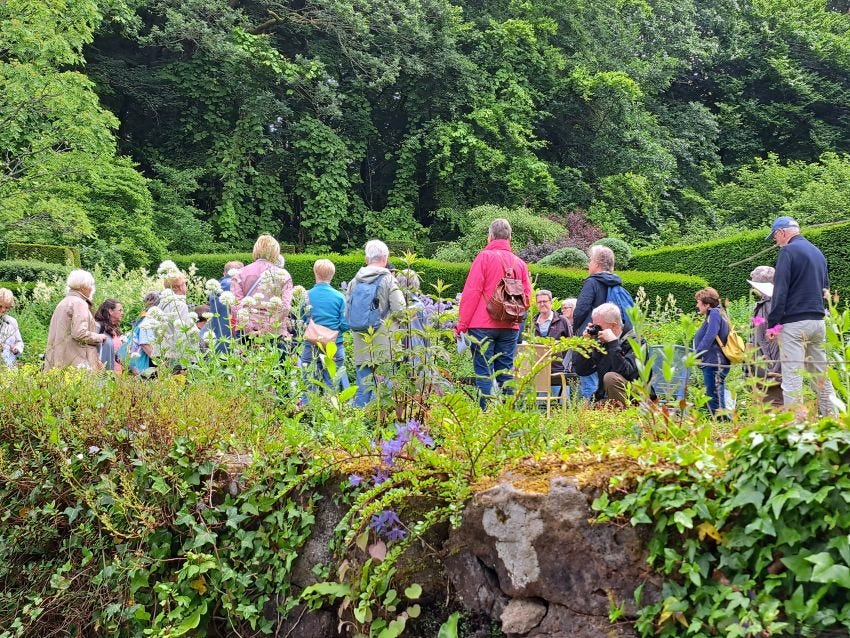
Visitors
But I look at it endlessly, always aiming to perfect the whole border.
It began like this, with us using carpet where we couldn’t get enough other mulch – a local carpet shop dropped a van load of offcuts. Some of which, I’m sad to say, remain in places as archaeology.
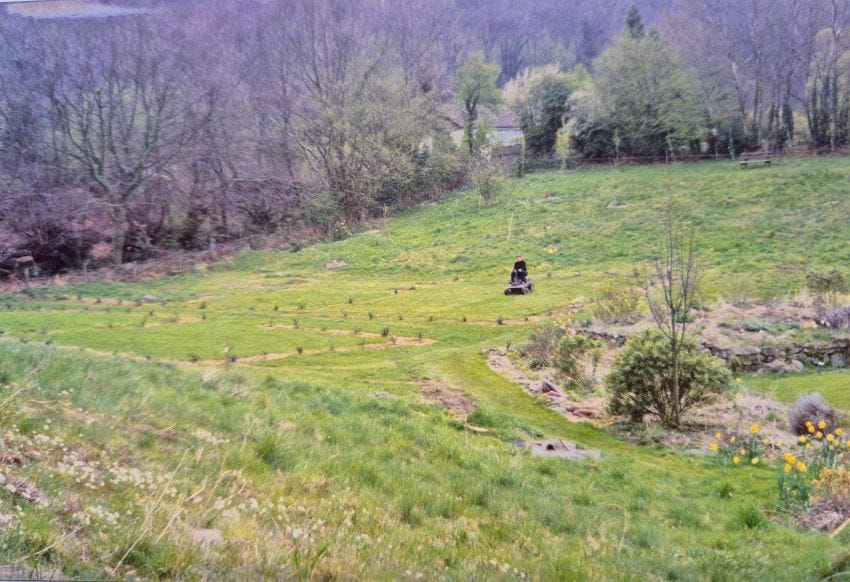
So here we are – me on the go-cart mower, cutting round the yew hedge to be. And the Crescent Border on the right. With carpet.
The big issue in those early days was, surprisingly, getting enough plants. I grew most things from seed and my bible was Plants for Ground Cover by Graham Stuart Thomas. I searched seed catalogues for anything I could find from the book. And I would also treat myself to plants from anywhere where I could lay my greedy mitts on them. If I could afford them and they were promised to be thuggish.
Apparently this is the initial result on one side –
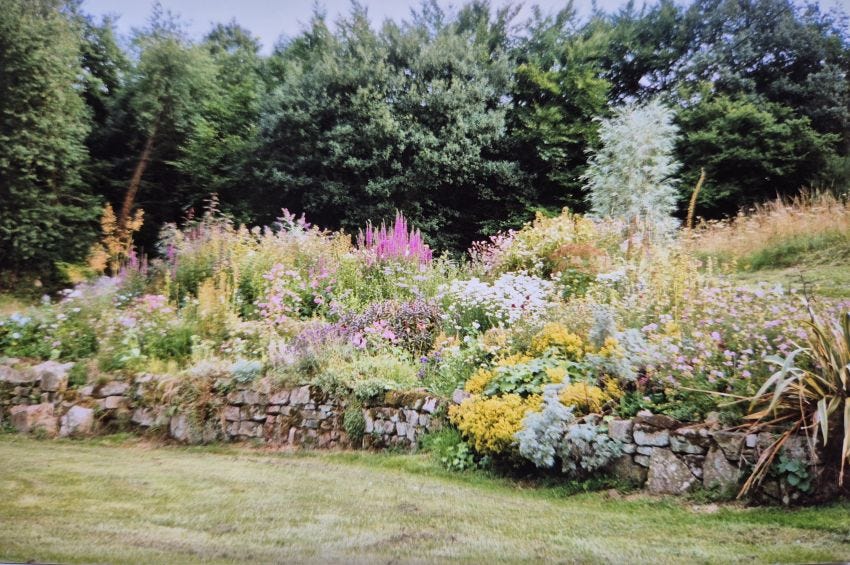
Maybe you can tell me what all these are – I cannot remember this at all. There’s some foxgloves! Quite pretty.
The tree is paired with another at the other end of the border, and is Sorbus hupehenensis – grey leaved and white berried. My other plant bible in my early days was Robin Lane Fox’s ‘Better Gardening’. I see that a review on Amazon says, rather inelegantly, ‘A now rather old fashioned book’. And Robin Lane Fox is just that, but he also knows about plants. We love the trees. And his other recommendations were useful too.
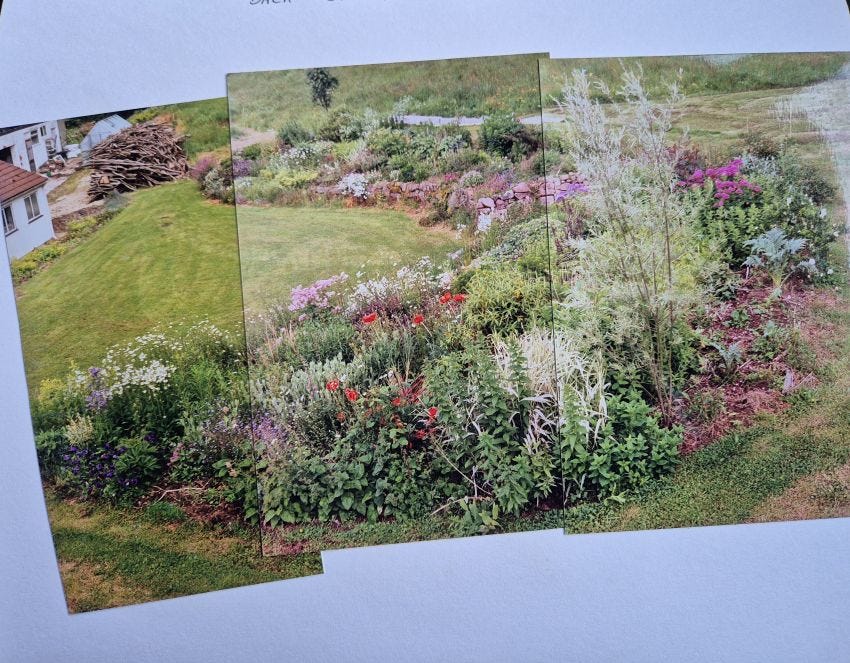
A panorama! And the endless wood pile….
So somehow I filled the border and began the endless process of feeling dissatisfied with it.
But two additions were pivotal. I bought Epilobium angustifolium ‘Stahl Rose’ – a beautiful form of Rosebay willow herb. You may fear it would spread, I long for it to spread more. But it has seeded quite a bit (seems to vary from year to year how much) – and it makes a great complement to one of the garden’s star plants: Campanula lactiflora. It begins to flower in June.
If people buy this plant they tend to get ‘Pritchard’s Variety’ which is reputed to be the best form. I got seeds and so instead I have taller ones in a variety of all shades of blue. Which works as unity with variety. A great design idea.
It has also seeded happily round the garden, which makes me happy too. When it is in flower visitors always want to know what it is, and it does the Chelsea Chop well too, giving it two seasons if you cut it judiciously. In August after a chop it will flower at a lower height, but despite its earlier full height of about four feet it stands on its own feet without stakes. Its one problem is that it goes over while all else is still flowering and that can look unsightly. So vast quantities have to be cut and removed.
One year lots of people asked if we had it for sale. I don’t sell plants, but I was keen to be obliging so grew some for sale the following year. Didn’t sell one.
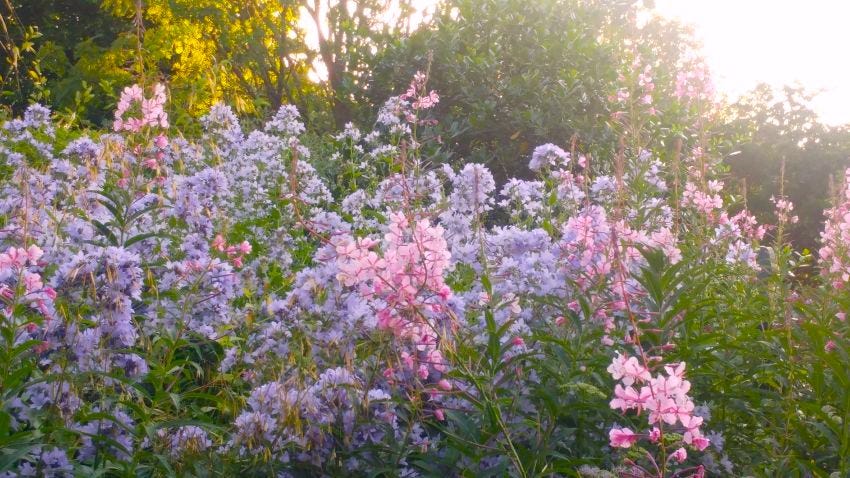
Here they are.
And here in the border.

At the front of that photograph is Alchemilla mollis with a variety of blue geraniums. Mowing keeps the edge – no horrible edging tool and task. A strim to the ground of it all, after the Alchemilla has flowered, has the whole border revive in 10 days and then looks good, if quiet, for the rest of the season.

And, oh, yes, we know what the problem with all that is. There was not much there earlier in the year. That’s ok with me – I’m a deferred gratification person.
But then there’s later. (Never trust a photo of a garden in midsummer glory. What happens next???) So I added …wait for it, it has endless names! – Koenigia alpina, Persicaria alpina, Polygonum polymorphum, Persicaria polymorpha. That’s the white plant in the middle:
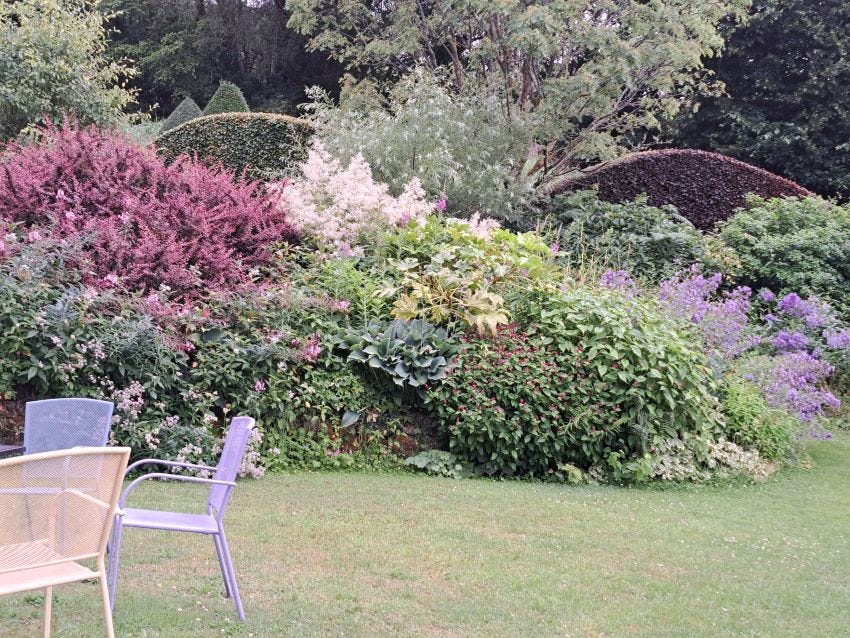
This is July .
Well, I planted one. I loved it! And the ‘alpina’ name, which somehow suggests it’s small. But it’s huge! And it starts white then slowly fades into pink. So it lasts and lasts. So I had to have two, then realised I needed it it throughout the border. I think there are six now. (Bad news though – sometimes, no idea why, it smells horrible!)
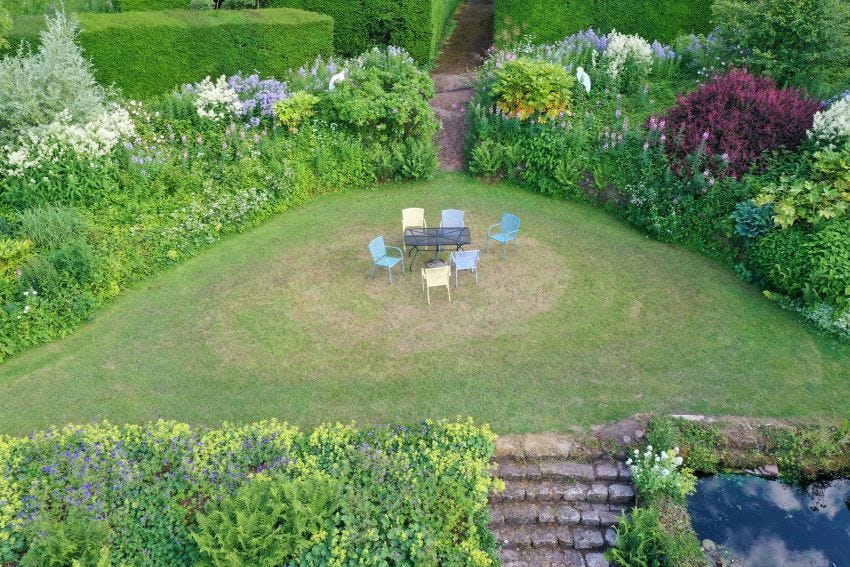
This is not the entire border. You may well wonder what that great big berberis is doing there. It does have a pair (small, afterthought again) on the left, out of sight.
And then we need more to follow. That’s late July when the epilobium is over, and the campanula yet to start again. So I added the real Veddw signature plant: Persicaria campanulata/Koenigia campanulata. This will flower from July to the frosts. It is a drought indicator – droops. But so far has survived and thrives in multitudes here.

Here it is, white, towards the front, and scattered around. It weaves in amongst. And there is the monster Koenigia alpina, while still a baby, fading to buff pink at the back. Yellow also emerges now, with various helianthus.
I’m boring your pants off with all this to try to communicate how this untrained novice garden maker feels a way through many years to put things together. Never had a plan. That no doubt shows. But I do have star plants, with a long flowering season (or good foliage), repeated. With additional frivolous bits and pieces added to try and make it all work for a long long season. If they survive. I have tried to get fennel in there seeding around unsuccessfully for years. And it is demanding, because perennials take some years to establish and do their best. People horrify me now and again by talking of dividing them after some years. A nightmare thought and very unlikely activity here.
So let’s just look through the seasons with this project. Pure self indulgence.


It’s worth imagining what it all looks like in the pouring rain. These are (as garden photos tend to be) very selected pictures!
Charles:
In that first picture of all the people on the lawn: they are not looking at the border, they are looking at me! That’s where we get visiting groups to assemble and I give them a hugely informative and very funny 10 minute talk about the place and then we send them off to explore. We are averse to guided tours as its just A Very Bad Way of enjoying a garden visit. I just want to say that I think Anne has done a fantastic job of refining the Crescent Border planting to give us joy for most of the year.
I’m anxious that the Sorbus trees are not going to last much longer!

And here’s an award winning photo by Charles. Of a bit of the Border.
And where we are:


I love this series. 21 years in my house and your process is so like mine! I have designed for others for decades, but in my own gardens, I continuously stare at the gardens, thinking of how to make them better. I also enthusiastically embrace hugging plants, Persicarias topping my list as I have very heavy clay soil and they love it. I hope to see your garden in person someday.
I do hope you come to enjoy my persicarias one day!
While I enjoy reading about English gardens, they are not what I like. They are too contrived and too formal.
Would never call Anne’s and Charles’ garden contrived or formal.
Well, it would be new!
How wonderful. I understand the progression through time. Usually, it is 9 years from blank canvas to something that appears to have been nurtured, but I’ve been 12 years in my current property and even with the natives that just come fill in all the holes it is still thin! Moving from 35 years in a shaded garden on 1/3 acre to full sun on 4 acres has been quite an adjustment. Large shrubs and some interesting trees have helped but they are young yet also!
It has been a great journey following your endeavors and so good to know that changes over time bring greater joy perhaps than having everything in place early. Thanks for all the work and Charles’ great pictures. I really love the winter one.
i hope I can continue to encourage you in your 4 acres and full sun!
Thank you for writing this!
It is encouraging to see the history of this part of your garden.
Nothing is done in a day or a year or maybe a lifetime…
I used discarded carpets when I began my latest garden. It is a small 65 sq m plot. Neighbors were not pleased.
Ha! Oh, those neighbours – let them try to make a new garden!
Oh, I love Persicaria Polymorpha. I have just one in my front garden. I adore tall plants, and this is not only tall, but gets quite thick, very shrub-like. I also love a good thug plant, as long as it’s not too naughty.
But have you noticed that in some weather (not sure what) and not often, it smells horrible?? But I do love it, and it makes that border.
Yes! I love to walk around, take in the view, the broad picture of the garden… then focus on specific plants. The best of both worlds. Thanks for writing, and illustrating, the history of making a garden at Veddw. It is so very encouraging. Our new garden is on a hill, or a variety of slopes, with brushy woods all around. A lot of scope for the next 20 years.
Good luck with it!
Oh my goodness; when I am discouraged about making over our yard, I will look at your process in pictures and soak in the inspiration. I ordered a bare root persicaria polymorpha on Etsy from a seller with good reviews. I can’t wait to see it flourish into a pretty backdrop for a corner of our front border. Enjoying following your story.
I love that plant – but it does smell funny sometimes. If you find yourself wondering about an odd smell, it will probably be that. Took me ages to find that out.